
Cancer Cell Signaling & Regulation
Cancer Cell Signaling
Growth Factor Signaling
Growth factor signaling regulates numerous cellular processes, including differentiation, survival, migration, and proliferation. Growth factors signal through cell-surface receptors including EGFRs, FGFRs, VEGFRs, PDGFRs, IGF-1R, and TGF-βRs to downstream pathways including the PI3K/Akt, RAS/RAF/MEK/ERK, and PLC/PKC pathways. Dysregulation of growth factor signaling through alterations in growth factor synthesis, growth factor receptor function and/or expression, and downstream signaling pathways can contribute to numerous hallmarks of cancer, including sustained proliferative signaling, evasion of growth suppressors, resistance to cell death, induction of angiogenesis, and activation of invasion and metastasis.
- Growth Factor Receptor Assay Kits
- EGFR/ErbB/HER Family Inhibitors
- FGFR Family Inhibitors
- IGF-1R Inhibitors
- VEGFR Family Inhibitors
- PDGFR Family Inhibitors
- TGF-βR Inhibitors
VIEW ALL:
GROWTH FACTOR SIGNALING PRODUCTS FOR CANCER RESEARCHGROWTH FACTOR SIGNALING PRODUCTS FOR CELL BIOLOGY RESEARCH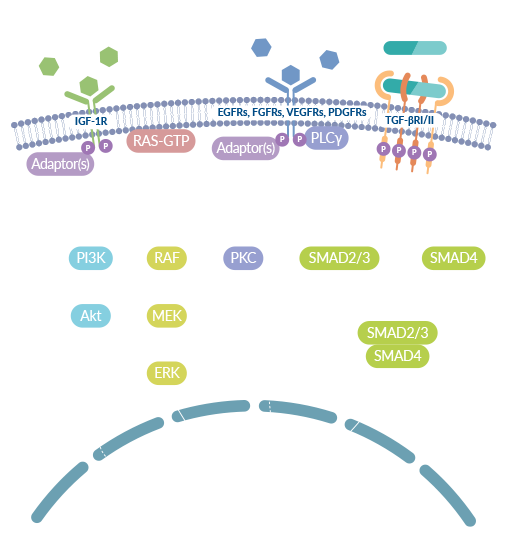
Learn more about growth factor receptor signaling in cancer, including notable mutations and therapeutics
Read The Article
Wnt, Hedgehog, & Notch Signaling
The Wnt, Hedgehog (Hh), and Notch pathways are major developmental signaling pathways that regulate cell proliferation, migration, and differentiation and are dysregulated in many types of cancer. Aberrant signaling of these pathways has been found in lung, breast, and gastric cancers, among many others, where they are involved in tumorigenesis, tumor progression, and the epithelial-to-mesenchymal transition (EMT). The Wnt, Hh, and Notch pathways are also involved in the self-renewal process in both normal and cancer stem cells (CSCs), as well as growth, apoptosis inhibition, and metastasis of CSCs.
Cell Cycle & DNA Damage
The cell cycle is a tightly regulated process of cell growth, DNA replication, and cell division. Progression through the phases of the cell cycle is controlled by cyclins in association with cyclin-dependent kinases (CDKs). Throughout this process, cells encounter several checkpoints designed to detect and correct issues such as DNA damage or improper spindle formation before allowing continuation of the cell cycle. Dysregulation of the cell cycle and checkpoint mechanisms can lead to aberrant proliferation and genomic instability and is often observed in cancer cells.
VIEW ALL:
CELL CYCLE PRODUCTSDNA DAMAGE & REPAIR PRODUCTSCell Cycle & DNA Damage
Learn more about and find research tools to study the cell cycle, DNA damage and repair, and cell cycle checkpoints in cancer.
Download The BrochureCell Death
Programmed cell death pathways such as apoptosis provide protection against cancer growth, tumor initiation, and metastasis by eliminating mutated and/or damaged cells. Upregulation of anti-apoptotic proteins, including Bcl-2, Bcl-xL, Mcl-1, and IAP proteins, is observed in numerous types of cancer, leading to dysregulation and suppression of apoptosis. Several inhibitors of these proteins are approved as anticancer therapeutics, with more currently in clinical trials. Additional cell death pathways such as necroptosis, ferroptosis, and pyroptosis also serve as protection against cancer and present novel targets for therapeutic development.
FEATURED PRODUCTS:
BROWSE PRODUCTS BY CELL DEATH PATHWAY AND RESEARCH AREA
- Apoptosis (For Cancer Research | For Cell Biology Research)
- Ferroptosis (For Cancer Research | For Cell Biology Research)
- Necroptosis
- Pyroptosis
VIEW ALL:
CELL DEATH PRODUCTS FOR CANCER RESEARCHCELL DEATH PRODUCTS FOR CELL BIOLOGY RESEARCH
CELL DEATH MECHANISMS &
DETECTION TOOLS
Explore cell death pathways in greater detail and find pathway-specific research tools and advice in our comprehensive guide.
DOWNLOAD THE GUIDE (PDF)Epigenetics
Alterations in epigenetic mechanisms such as DNA methylation and post-translational modification of histone proteins can contribute to dysregulation of gene expression and are often observed in cancer.
Epigenetics Screening Library (96-Well)
- >140 compounds
- Includes modulators of writers, erasers, and readers
SGC Probe Set
- >30 compounds from the Structural Genomics Consortium (SGC)
- Includes inhibitors/antagonists of writers, erasers, and readers
DNA Methylation
DNA methylation at CpG sites to form 5-methylcytosine (5mC) is catalyzed by the DNA methyltransferase (DNMT) family members DNMT1, DNMT3a, and DNMT3b. Altered expression of or mutations in DNMTs can lead to dysregulation of DNA methylation patterns. Global DNA hypomethylation is related to genomic instability, DNA damage, and activation of oncogenes, whereas hypermethylation can silence tumor suppressor genes and promote malignancy.
Histone Modification
Histone proteins can be modified by processes including acetylation, methylation, phosphorylation, citrullination, and more. These modifications affect chromatin structure and gene expression and are frequently altered in cancer.
Histone Acetylation
Acetylation of lysine (K) residues on histone tails is associated with decondensation of chromatin and active transcription. It is catalyzed by histone acetyltransferases (HATs), whereas histone deacetylases (HDACs) and sirtuins (SIRTs) are responsible for deacetylation. Acetylated histone lysines are recognized by “reader” proteins possessing a bromodomain (BRD) motif, including members of the BRD and extraterminal domain (BET) protein family. Aberrant expression of HATs, HDACs/SIRTs, and BRD proteins occurs in various types of cancer, underscoring the importance of maintaining the correct balance of acetylation for cell health. Altered levels of acetylation at specific residues have potential value as prognostic markers, such as reduced acetylation of histone H3 lysine 9 (H3K9Ac), which is associated with poor prognosis in breast, gastric, and ovarian cancers.
Histone Methylation
Histones can be methylated on either lysine or arginine (R) residues by lysine methyltransferase (KMT) and protein arginine methyltransferase (PRMT) “writers”, respectively, resulting in either activation or repression of gene expression, depending on a number of factors such as the specific histone residue undergoing methylation and the number of methyl groups added. Methyl groups can be removed by demethylase “erasers” and recognized by “readers” that possess chromodomains, WD40 repeats, malignant brain tumor (MBT) domains, Tudor domains, and plant homeodomain (PHD) finger motifs. Histone methyltransferases and demethylases are commonly dysregulated in cancer and, as in the case of histone acetylation, alterations in histone methylation can serve as potential prognostic markers. In breast cancer, for example, reduced levels of dimethylation at histone H3 lysine 4 (H3K4Me2), trimethylation at histone H4 lysine 20 (H4K20Me3), and dimethylation at histone H4 arginine 3 (H4R3Me2) are associated with poor prognosis.
- Methylated Histone Antibodies
- Methylated Histone Peptides
- Histone Methyltransferase Inhibitors
- Histone Methyltransferase Proteins
- Histone Methyltransferase Assay Kits
- Histone Demethylase Inhibitors
- Histone Demethylase Proteins
- LSD1 Inhibitor Screening Assay Kit
- See all Chromodomain, MBT Domain, PHD Domain, Tandem Tudor & Tudor-like Domain and WD40 Repeat Domain products