
Lipids for LNP Targeting: Passive & Active Approaches
Featured Brochures
Cayman offers a comprehensive portfolio of high‑purity lipids and conjugation‑ready components designed to support both passive and active targeting strategies in lipid nanoparticle (LNP) formulation. From ionizable cationic lipids to PEGylated and ligand‑modified components, our solutions help researchers optimize LNP stability, biodistribution, and targeted delivery for advanced therapeutic applications.
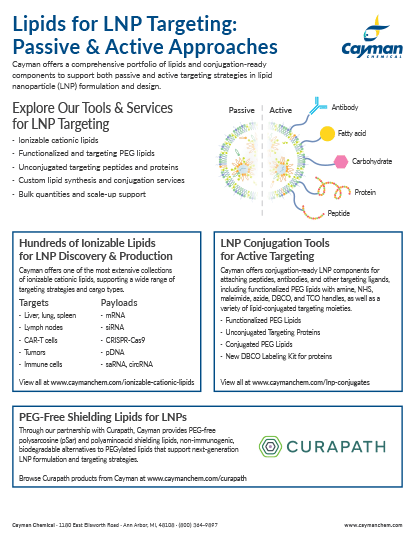
SM-102-based Lipid Nanoparticles as a Benchmark for the Development of Novel Formulations
Application notes
Effective Screening of LNP Formulations with Centrifugal Microfluidics Devices
Scientific posters
Lipid Nanoparticle (LNP) Components Dictate the Cellular Immune Response to Vaccination
Scientific posters
In this study, we formulated LNPs with SARS-CoV-2 Spike mRNA as a model antigen. The LNPs were based on established ionizable lipids, and some included putative adjuvants as additional components of the LNPs. A cohort of mice was immunized, and immune responses were assessed by ELISA for total and neutralizing antibody production, flow cytometry for T cell subsets, and ELIspot for Spike peptide-specific immune responses. We found that the different LNP formulations stimulated different aspects of the immune response, which can inform future approaches to vaccine development.
Do you have a question or comment for the presenter? Let us know.
To cite this poster: Rumble, J.M., Gronevelt, J.P., Blanks, A., et al. Lipid nanoparticle (LNP) components dictate the cellular immune response to vaccination. Poster presented at: The Annual Meeting of the American Association of Immunologists; May 3-7, 2025. Honolulu, HI.
Lipid Nanoparticle SARS-CoV-2 Vaccine-Mediated Immunopeptidome Identification
Scientific posters
In this study, LNPs encoding SARS-CoV-2 Spike protein were formulated with several different lipids proposed to stimulate immune responses. These LNPs were used to transfect human monocyte-derived dendritic cells (MDDCs), and Spike-derived MHC class I and class II peptides were identified. Evaluation of immunopeptidomic differences between these formulations as well as understanding of resulting immune responses will help the design of vaccine LNPs in the future.
Do you have a question or comment for the presenter? Let us know.
To cite this poster: Rumble, J.M., Gronevelt, J.P., Nyayapathy, S., et al. Lipid nanoparticle SARS-CoV-2 vaccine-mediated immunopeptidome identification. Poster presented at: The Annual Meeting of the American Association of Immunologists; May 3-7, 2025. Honolulu, HI.
Lipid Nanoparticle Screening in 2D vs 3D Cultures: Ovarian Cancer Cell Lines Exhibit Different Preference for Optimal Lipid Formulation in Monolayers vs Spheroids
Scientific posters
In this study, we investigated the expression of three different nucleic acid cargo types (mCherry mRNA, GFP DNA and Cy5-labeled 2′3′-cGAMP) delivered to three different ovarian cancer cell lines via four loadable LNPs containing benchmark lipids SM-102, ALC-0315, (S)-C12-200, or DLin-MC3. We then compared the relative efficacy of each formulation in delivering each payload to the various ovarian cancer cells (PA-1, SK-OV-3, and Caov-3) cultured as monolayers vs spheroids to assess whether the optimal LNP formulation is consistent across 2D and 3D culture models.
Do you have a question or comment for the presenter? Let us know.
To cite this poster: Taylor, D., Forsyth, V., Riddering, C., et al. Lipid nanoparticle screening in 2D vs 3D cultures: Ovarian cancer cell lines exhibit different preference for optimal lipid formulation in monolayers vs spheroids. Poster presented at: American Association for Cancer Research Annual Meeting 2025; April 25-30, 2025; Chicago, IL.
Lipid Nanoparticle-Mediated In Vitro Transfection of Microbubble-Activated T Cells
Scientific posters
CAR-T cell therapy is a groundbreaking form of immunotherapy, with seven US FDA-approved therapies for hematological malignancies and ongoing investigations for solid tumors. This autologous therapy includes harvesting patient’s T cells, engineering them to express CAR constructs, and transfusing them back into the patient to target and destroy cancer cells. In this study, we evaluated five LNP formulations to express a reporter gene (eGFP mRNA) in microbubble-CD3/CD28-activated T cells and stimulated with IL-2 and IL-7.
Do you have a question or comment for the presenter? Let us know.
To cite this poster: Nyayapathy, S., Gronevelt, J.P., Holcomb, E., et al. Lipid nanoparticle-mediated in vitro transfection of microbubble-activated T cells. Poster presented at: American Association for Cancer Research Annual Meeting 2025; April 25-30, 2025; Chicago, IL.
Enhancing Transfection Efficiency of Primary Immune Cells Through Lipid Nanoparticle-mediated Delivery
Scientific posters
Biodistribution Assessment of Lipid Nanoparticle-Mediated mRNA Delivery Using In Vivo Imaging
Application notes
Key Features
- Cayman’s LNP development services in partnership with Labcorp utilizes in vivo imaging technology to create a comprehensive LNP screening platform.
- With this approach, three LNP formulations were assessed in vitro and in vivo for potency of reporter gene expression and differential organ delivery.
- This comprehensive LNP formulation, characterization, and analysis service can be used to identify candidate LNP formulations with tissue-tropic distribution.
Lipid Nanoparticles for Nucleic Acid Therapies
Lab Wall Posters
- Selection of lipids, cargo, and microfluidic mixing parameters
- Nucleic acid cargoes, their biological targets, and effects
- Techniques for LNP particle analysis and methods for biological assessment
- Approaches for targeted LNP delivery
In Vivo Investigation of pDNA Delivery Using Various Lipid Nanoparticle Formulations in A549 and Huh7 Cell Lines
Scientific posters
In this study, we investigated the efficiency of LNPs loaded with GFP-encoding pDNA using several previously published ionizable lipids, including DLin-MC3-DMA (MC3), CIN-16645 (LP-01), ALC-0315, 4A3-SC8, and DOTAP (SORT), SM-102, and β-sitosterol as a cholesterol analogue in SM-102. Key formulation characteristics, such as polydispersity index (PDI), Z-average diameter (Z-Avg), encapsulation efficiency (%EE), and freeze-thaw stability, were examined through plate-based methods. Our results show that all LNP formulations achieved ≥85% encapsulation of pDNA-eGFP with PDI values ≤0.10, indicating efficient nanoparticle formation. Next, we evaluated the transfection efficiency and mean fluorescence intensity (MFI) of pDNA-loaded LNPs in Huh-7 hepatocytes and A549 lung epithelial cells. We show that pDNA-eGFP-loaded LNPs exhibited comparable GFP intensities, with slightly lower transfection efficiencies than mRNA-loaded LNPs. Both Huh-7 and A549 cells were successfully transfected with pDNA-encapsulated LNPs
Do you have a question or comment for the presenter? Let us know.
To cite this poster: Konopka, S., Stewart, S., Gronevelt, J.P., et al. In vivo investigation of pDNA delivery using lipid nanoparticle formulations in A549 and Huh7 cell lines. Poster presented at: Cell Bio 2024; December 14-18, San Diego, CA.
Modulation of ENPP1 Activity and 2´3´-cGAMP Degradation in Ovarian Cancer Cell Lines via Loadable Preformed Lipid Nanoparticles
Webinars
Ectonucleotide pyrophosphatase/phosphodiesterase 1 (ENPP1) suppresses innate immunity and promote tumor progression and metastasis in the tumor microenvironment. ENPP1 inhibits STING signaling by hydrolyzing the degradation of 2',3'-cGAMP, blunting induction of the type 1 interferon response and antitumor immunity.
Listen as David Taylor, Ph.D., a scientist in Cayman's Assay Research & Development group, modulates ENPP1 expression and STING activation in ovarian cancer cell lines and macrophages with LipidLaunch™ Loadable LNPs and explores the contribution of ovarian cancer cell-derived extracellular vesicles in the tumor microenvironment.
Presented as part of the 2024 Tumor Microenvironment and Therapy Symposium at The University of Michigan.
Read the Webinar Highlights for a quick overview of the key takeaways.
Do you have a question or comment for the presenter? Let us know.
mRNA Delivery to Activated Primary Human T Cells Using C14-4 Lipid Nanoparticles
Application notes
Key Features
- Primary immune cells, especially T cells, are challenging to transfect due to their natural resistance to foreign genetic material.
- Lipid nanoparticles (LNPs) offer improved efficiency with reduced cytotoxicity compared with traditional transfection methods.
- This workflow can be used with LNPs for the delivery of mRNA to achieve optimal protein expression in activated primary human T cells.
Apolipoprotein E: Purification, Characterization, and Lipid Nanoparticle Uptake Enhancement
Scientific posters
Beyond its implications in disease, apoliporotein E (ApoE) has been implicated in the intricate process of lipid nanoparticle (LNP) uptake. Recent studies have revealed the essential role of ApoE in facilitating the cellular internalization of LNPs, providing a potential avenue for targeted drug delivery and therapeutic interventions. In this study we have expressed and purified all three ApoE isoforms and characterized their binding properties to cognate ligands by surface plasmon resonance (SPR). Furthermore, we show that Cayman-produced LNP uptake is enhanced by addition of exogenous ApoE in a cell-based assay with lung epithelial cells.
Do you have a question or comment for the presenter? Let us know.
To cite this poster: Guerra, A.J., Muzzarelli, K.M., Gronevelt, J.P., et al. Apolipoprotein E: Purification, characterization, and lipid nanoparticle uptake enhancement. Poster presented at: PEGS Boston Summit; May 13-17, 2024. Boston, MA.
Ionizable Cationic Lipids: From R&D to GMP Excipient
Brochures
Modulation of ENPP1 Activity and 2’3’-cGAMP Degradation in Ovarian Cancer Cell Lines via Loadable Preformed Lipid Nanoparticles
Scientific posters
LipidLaunch™ Research Tools for LNP Discovery
Brochures
Encapsulation and Transfection of RNA Using LipidLaunch™ SM-102 Lipid Nanoparticles (Loadable)
Application notes
Key Features
- Cayman’s LipidLaunch™ SM-102 LNP Kit (Loadable) is comprised of lyophilized SM-102-based lipid nanoparticles (LNPs) prepared without cargo.
- Allows researchers to encapsulate RNA cargo of choice for LNP-mediated transfection without microfluidic mixing devices.
- Enable RNA delivery to difficult-to-transfect cell lines and primary cultures.
- LipidLaunch™ SM-102 LNPs (Loadable) facilitate effective RNA transfection with minimal cytotoxicity compared to traditional transfection reagents.
Cayman Currents Issue 36: Lipid Nanoparticles
Cayman Currents
Lipid Nanoparticle Development Services
Brochures
Lipid nanoparticles (LNPs) represent an extremely promising technology for delivery of gene products for a host of potential health applications, from immunization against emerging pathogens to personalized neoantigen cancer therapy and gene therapy for many diseases. Combining our industry-leading expertise in lipid chemistry, synthesis, and analysis with proficiencies in bioanalysis and cell biology, Cayman offers comprehensive services to support LNP development, characterization, and screening.
Ionizable Lipid Composition Influences Lipid Nanoparticle Efficacy in Multiple Cell Types In Vitro
Application notes
Key Features
- Cell lines derived from different tissues have distinct reporter expression patterns in response to a variety of lipid nanoparticles (LNPs).
- Serum requirement for LNP uptake and cargo expression in vitro vary with cell type and ionizable lipid.
- Experimental design is of utmost importance in assessing the efficacy of any given LNP preparation.
Immunology and Inflammation
Brochures
Inflammation is the immune system's response to potential danger signals and damage. The coordination of immune cells, inflammatory lipid mediators, and cytokines act to mount the appropriate immune response, resolve inflammation, and restore homeostasis. Immunomodulation is a powerful strategy that can be used to revolutionize the treatment of autoimmune diseases, cancer, and countless other inflammation-related disorders. Cayman offers a wide range of tools to help you study the factors related to innate and adaptive immune responses.
Integrated Drug Discovery Services
Brochures
Make, characterize and optimize LNPs with Nunchuck & Stunner
Webinars
Listen as Julie Rumble, PhD, Director of Immunology Services at Cayman Chemical, discusses the workflow for formulation, analysis, and testing of LNPs in multiple cell types.
Presented by Unchained Labs and Fierce Biotech.
Do you have a question or comment for Dr. Rumble? Let us know.
Lipid Nanoparticle Research Tools
Brochures
Contact Info
Cayman Chemical1180 East Ellsworth RoadAnn Arbor, Michigan 48108 USAToll Free: (800) 364-9897(USA and Canada only)Fax: (734) 971-3640


