
News & Announcements
Serum Albumins as Carriers for Fatty Acid Delivery
Article from 2025-10-24
By Garrett Johnson, Technical Writer, Cayman Chemical
BSA-fatty acid complexes are commonly used in cell culture and biochemical assays to deliver fatty acids in a physiologically relevant way. Cayman offers a variety of HSA- and BSA-FA complexes at different ratios and molarities for diverse assay needs, packaged in a convenient, ready-to-use format.
Fatty Acids
Fatty acids are molecules that are necessary for cellular metabolism, specific gene regulation, and membrane structure.1,2 They are classified into short-, medium-, long-, and very long-chain fatty acids, each with their own sets of cellular activity.3 Fatty acid diversity is increased by differences in saturation, stereochemistry, or branching, factors that can have effects on metabolism, signaling, and membrane composition. However, solubility in aqueous media poses a challenge for hydrophobic lipids, such as long-chain fatty acids (LCFAs) and very long-chain fatty acids (VLCFAs), and complicates efforts to deliver these molecules into cells.4,5 Unless a carrier is used, increasing fatty acid concentrations in the media may not enrich cellular environments to the extent desired, owing to both solubility limitations and lipotoxicity.6
Organic Solvents for Fatty Acid Delivery
To address the issue of low solubility, organic solvents have been used to help solubilize LCFAs and VLCFAs.7,8 By applying heat and solvents, namely ethanol or DMSO, fatty acids are solubilized to a greater degree than just adding them to the culture media. However, this approach is not without difficulties or challenges. Both ethanol and DMSO can be hazardous to cells at too high of a concentration and can impact signaling pathways independent of fatty acid-induced changes, compromising assay quality and integrity.9 Fortunately, there is another method to deliver LCFAs and VLCFAs exogenously, which is based on how these fatty acids are solubilized naturally.8
Albumin for Physiologically Relevant Fatty Acid Delivery
In the human body, albumin is the chief transporter of LCFAs and VLCFAs.6,10 Since most cells cannot synthesize these molecules, albumin acts as a carrier to ensure proper lipid homeostasis throughout the body.6 Both human serum albumin (HSA) and bovine serum albumin (BSA) have been used in the lab to solubilize fatty acids via their multiple fatty acid binding sites to form a serum albumin:fatty acid (SA-FA) complex.10-12 Although HSA is used to conjugate fatty acids in experiments where immunogenicity is a concern, BSA has primarily been used owing to its prevalence and ubiquity in the laboratory.7 HSA- and BSA-fatty acid (BSA-FA) complexes formed in this way serve as reservoirs of fatty acids that are delivered into the cells by protein-mediated transport or diffusion without the need of organic solvents (Figure 1). These complexes can be used to deliver various fatty acids to cells for a variety of uses, including to study mitochondrial function, pro-inflammatory pathways, enzyme inhibition, or cancer cell growth.13,14 However, these HSA- and BSA-FA complexes must be carefully prepared before any experiment can be conducted.
Figure 1. Potential pathways for BSA-FA complexes to increase intracellular FA levels. Effects on cells are FA-specific. Figure is adapted from Schwenk, R.W., Holloway, G.P., Luiken, J.J.F.P., et al. Fatty acid transport across the cell membrane: Regulation by fatty acid transporters. Prostaglandins Leukot. Essent. Fatty Acids 82(4-6), 149-154 (2010).
Parameters for High-Quality Fatty Acid Complexes
Despite the straightforward process of preforming these complexes, each step must be well conducted to ensure high quality of the final reagent and consistency in future assays and experiments.7 The serum albumins and fatty acids must be of high purity to ensure batch-to-batch quality and consistency. Careful control of the conditions around complexation ensures a consistent product batch-to-batch and precision of the resulting SA:FA ratio. This ratio is important not only for delivery of a known amount of FA to cells, but also to minimize the availability of free BSA, which can induce toxicity in cell culture systems. Use of consistent products can enhance reproducibility of downstream experiments and minimize experimental failure.
Fortunately, Cayman provides a variety of HSA- and BSA-FA complexes at different ratios and molarities for diverse assay needs, all packaged in a convenient, ready-to-use format. Whether these complexes will be used to induce lipid toxicity, study mitochondrial and peroxisomal maintenance in a variety of cells and models, improve production yields in expression systems, or for another purpose, Cayman's HSA- and BSA-FA complexes can simplify assay development and ensure experimental outcome consistency. Cayman's fluorescently labeled BSA-FA complexes can be used to identify lipid cellular localization. Additionally, Cayman also provides fatty acid-free BSA controls and isotopically labeled BSA-FA complexes to ensure FA-specific cellular effects.
Our Most Popular Fatty Acid Complexes
| Item Number | HSA/BSA-FA Complex Name | FA:HSA/BSA Ratio | FA Chain |
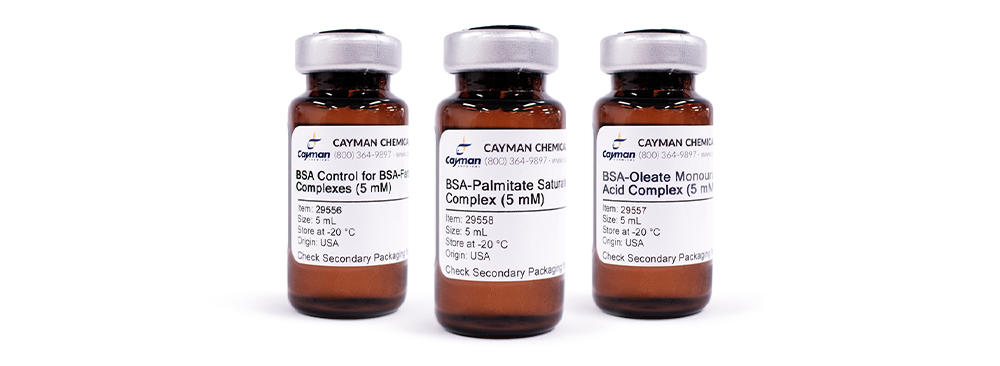
| 29558 | BSA-Palmitate Saturated Fatty Acid Complex (5 mM) | 6:1 | 16:0 |
| 44156 | BSA-Palmitate Saturated Fatty Acid Complex (10 mM) | 6:1 | 16:0 |
| 43209 | BSA-13C16-Palmitate Saturated Fatty Acid Complex (5 mM) | 6:1 | 16:0 |
| 29557 | BSA-Oleate Monounsaturated Fatty Acid Complex (5 mM) | 6:1 | 18:1 |
| 38649 | BSA-Linoleate ω-6 Polyunsaturated Fatty Acid Complex (1 mM) | 6:1 | 18:2 |
| 39149 | BSA-γ-Linolenate Polyunsaturated Fatty Acid Complex (1 mM) | 6:1 | 18:3 |
| 34931 | BSA-Arachidonate Polyunsaturated Fatty Acid Complex (1 mM) | 6:1 | 20:4 |
| 35872 | BSA-Docosahexaenoate Polyunsaturated Fatty Acid Complex (1 mM) | 6:1 | 22:6 |
View all fatty acid complexes available from Cayman
BSA Controls Available from Cayman
| Item Number | BSA Control Name |
| 34932 | BSA Control for BSA-Fatty Acid Complexes (1 mM) |
| 29556 | BSA Control for BSA-Fatty Acid Complexes (5 mM) |
| 44217 | BSA Control for BSA-Fatty Acid Complexes (10 mM) |
Cayman offers a variety of HSA- and BSA-fatty acid complexes at different ratios and molarities for diverse assay needs, packaged in a convenient, ready-to-use format to help streamline workflows. Download the Brochure: BSA Complexes for Cellular Delivery of Fatty Acids |
Sample Protocol for the Delivery of Fatty Acid Complexes
Provided below is an example protocol for using Cayman's fluorescently tagged BSA-NBD-Stearate Saturated Fatty Acid Complex (1 mM) (Item No. 44253) and other reagents for intracellular labeling of lipids.
Plate cells at the desired density for imaging. Optional: After cell adherence, the media can be replaced with serum-free or reduced serum media.
After 24 hours, treat the cells or exchange media with 1-10 µM BSA-NBD-Stearate Saturated Fatty Acid Complex (1 mM) or BSA Control for BSA Fatty Acid Complexes (1 mM). Test a range of concentrations to identify an optimal labeling concentration for the cell line.
Additional cellular labels, such as Hoechst 33342 (Item Nos. 40797 | 15547) at 4-20 µM for nuclei staining or Nile Red (Item No. 30787) at 1 µM for neutral lipid labeling, can be added during the BSA:FA complex addition step to visualize additional cellular components and compare lipid localization, respectively.
After incubation, aspirate the media and wash the cells gently with warm PBS or media to remove excess fluorophore. Optionally, Phenol Red-free media can be added in this step.
Evaluate lipid uptake and cellular localization by fluorescence microscopy using a FITC/GFP filter set. BSA-NBD-stearate uptake can be observed with visible puncta and lipid-containing structures appearing within 30-60 minutes.
References
1. Currie, E., Schulze, A., Zechner, R., et al. Cellular fatty acid metabolism and cancer. Cell Metab. 18(2), 153-161 (2013).
2. Duplus, E., Glorian, M., and Forest, C. Fatty acid regulation of gene transcription. J. Biol. Chem. 275(40), 30749-30752 (2000).
3. Jie, M.S.F.L.K. and Pasha, M.K. Fatty acids, fatty acid analogues and their derivatives. Nat. Prod. Rep. 607-629 (1998).
4. Poulos, A. Very long chain fatty acids in higher animals—a review. Lipids 30(1), 1-14 (1995).
5. Stahl, A. A current review of fatty acid transport proteins (SLC27). Pflugers Arch. 447(5), 722-727 (2004).
6. Schwenk, R.W., Holloway, G.P., Luiken, J.J.F.P., et al. Fatty acid transport across the cell membrane: Regulation by fatty acid transporters. Prostaglandins Leukot. Essent. Fatty Acids 82(4-6), 149-154 (2010).
7. Alsabeeh, N., Chausse, B., Kakimoto, P.A., et al. Cell culture models of fatty acid overload: Problems and solutions. Biochim. Biophys. Acta Mol. Cell Biol. Lipids 1863(2), 143-151 (2018).
8. Wiesenfeld, P.W., Babu, U.S., and O'Donnell, M.W. Effect of long-chain fatty acids in the culture medium on fatty acid composition of WEHI-3 and J774A.1 cells. Comp. Biochem. Physiol. B Biochem. Mol. Biol. 128(1), 123-134 (2001).
9. Siddiqui, R.A., Jenski, L.J., Neff, K., et al. Docosahexaenoic acid induces apoptosis in Jurkat cells by a protein phosphatase-mediated process. Biochim. Biophys. Acta 1499(3), 265-275 (2001).
10. Trigatti, B.L. and Gerber, G.E. A direct role for serum albumin in the cellular uptake of long-chain fatty acids. Biochem. J. 308(Pt. 1), 155-159 (1995).
11. Tuei, V.C., Ha, J.-S., and Ha, C.-E. Effects of human serum albumin complexed with free fatty acids on cell viability and insulin secretion in the hamster pancreatic β-cell line HIT-T15. Life Sci. 88(17-18), 810-818 (2011).
12. Bhattacharya, A.A., Grüne, T., and Curry, S. Crystallographic analysis reveals common modes of binding of medium and long-chain fatty acids to human serum albumin. J. Mol. Biol. 303(5), 721-732 (2000).
13. Chausse, B., Kakimoto, P.A., Caldeira-da-Silva, C.C., et al. Distinct metabolic patterns during microglial remodeling by oleate and palmitate. Biosci. Rep. 39(4), BSR20190072 (2019).
14. Colquhoun, A. and Curi, R. Regulation of tumour cell fatty acid oxidation by n-6 polyunsaturated fatty acids. Biochem. Soc. Trans. 25(4), S681 (1997).
Contact Info
Cayman Chemical1180 East Ellsworth RoadAnn Arbor, Michigan 48108 USAToll Free: (800) 364-9897(USA and Canada only)Fax: (734) 971-3640


