
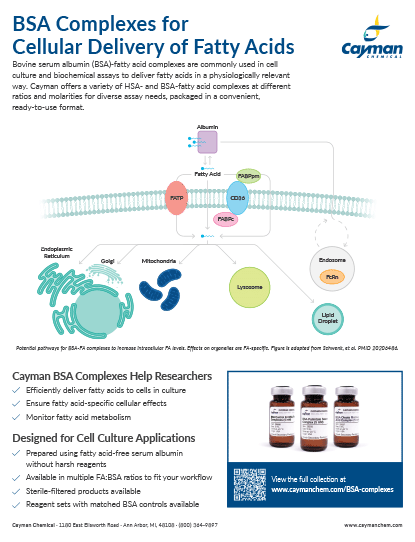
BSA Complexes for Cellular Delivery of Fatty Acids
Featured Brochures
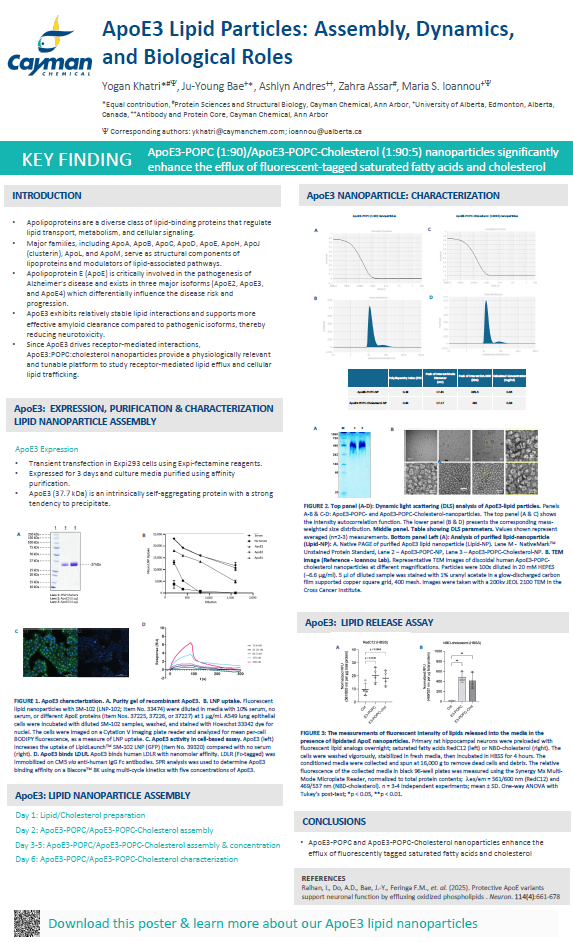
ApoE3 Lipid Particles Assembly, Dynamics, and Biological Roles
Scientific posters
Apolipoproteins are a diverse class of lipid-binding proteins that regulate lipid transport, metabolism, and cellular signaling. Major families, including ApoA, ApoB, ApoC, ApoD, ApoE, ApoH, ApoJ (clusterin), ApoL, and ApoM, serve as structural components of lipoproteins and modulators of lipid-associated pathways. Apolipoprotein E (ApoE) is critically involved in the pathogenesis of Alzheimer’s disease and exists in three major isoforms (ApoE2, ApoE3, and ApoE4) which differentially influence the disease risk and progression. ApoE3 exhibits relatively stable lipid interactions and supports more effective amyloid clearance compared to pathogenic isoforms, thereby reducing neurotoxicity. Since ApoE3 drives receptor-mediated interactions, ApoE3:POPC:cholesterol nanoparticles provide a physiologically relevant and tunable platform to study receptor-mediated lipid efflux and cellular lipid trafficking. Here we demonstrate how ApoE3-POPC and ApoE3-POPC-Cholesterol nanoparticles enhance the efflux of fluorescently tagged saturated fatty acids and cholesterol.
Do you have a question or comment for the presenter? Let us know.
To cite this poster: Khatri, Y., Bae, J.-Y., Anders, A., et al. ApoE3 Lipid Particles: Assembly, Dynamics, and Biological Roles. Poster presented at: 2026 Lipids@Wayne Research Symposium; May 5 – 6, 2026; Detroit, MI.
Evaluation of Quantification Capabilities of Untargeted Lipidomics Approaches
Application notes
We evaluated the accuracy of lipid quantitation in human plasma by LC-MS using single-point or multipoint calibration curves with authentic or surrogate standards.
Highlights:
- Both methods identified hundreds of lipids with precision and accuracy.
- Multipoint calibration curves outperformed single-point calibration curves.
- The proper selection of standards is critical for quantitation accuracy.
Characterization of Human Plasma as a Reference Material for Lipid Analysis Using LC-MS
Application notes
Key Features
- A preparation of human plasma has been characterized as a reference material for lipid identification and quantitation using LC-MS.
- The validity of the methods used and the values obtained is supported by the reasonable agreement with published values in NIST SRM 1950 plasma.
- MaxSpec® Reference Plasma (Human) can be used for quality control, method development, and performance validation in lipid studies.
- A list of lipid concentrations is made public and periodically updated.
To cite this application note: Kwiatkowski, M.J., Goodwin, S.K., DeLoy, S.L., et al. Characterization of human plasma as a reference material for lipid analysis using LC-MS. Application Note, Cayman Chemical Company (2025).
Evaluation of the Quantification Capabilities of Untargeted Lipidomics Approaches
Scientific posters
Untargeted lipidomics uses MS to analyze hundreds of molecular species in biological samples. Single-point calibration based on the known amounts of internal standards is used in many studies, especially those using shotgun (i.e., without chromatography) MS analysis, but questions remain about the accuracy of single-point calibration compared to the traditional interpolation in multipoint calibration curves, as well as its suitability in LC-MS studies, where internal standards may not coelute with most of the endogenous analytes.
The objective of this study is to assess the accuracy of quantitation of lipids in human plasma by LC-MS using either single-point or multipoint calibration curves with authentic or surrogate lipid standards, using a new preparation of human reference plasma and methods validated by comparison with published values from the NIST SRM 1950 Metabolites in Human Plasma material.
Do you have a question or comment for the presenter? Let us know.
To cite this poster: Kennedy, P.D., Palagama, D.S.W., Kwiatkowski, M.J., et al. Evaluation of the quantification capabilities of untargeted lipidomics approaches. Poster presented at: 73rd Conference on Mass Spectrometry and Allied Topics; June 1-5, 2025; Baltimore, MD.
Characterization of Human Plasma as a Reference Material for Lipid Analysis Using LC-MS
Scientific posters
Lipids are key molecules in maintaining cellular membranes, in energy storage, cellular signaling, and many other biological processes. Mass spectrometry has become the gold standard for analyzing lipids and understanding their roles in health and disease, and well-characterized reference materials increase confidence in lipid quantitative data by validating the analytical methods employed.
The objective of this study is to characterize a preparation of human plasma as a reference for the analysis of a wide variety of lipids, using both targeted and untargeted LC-MS-based methods which are validated by comparison with the NIST SRM 1950 Metabolites in Human Plasma material.
View the reference data (.xlsx)
Do you have a question or comment for the presenter? Let us know.
To cite this poster: Kwiatkowski, M.J., Goodwin, S.K., DeLoy, S.L., et al. Characterization of human plasma as a reference material for lipid analysis using LC-MS. Poster presented at: 73rd Conference on Mass Spectrometry and Allied Topics; June 1-5, 2025; Baltimore, MD.
Research Tools for Lipid Analysis by Mass Spectrometry
Brochures
Explore fundamental mechanisms of biology, identify biomarkers, and develop new therapies with high-purity lipid standards available from Cayman.
Analysis of Complex Mixtures of Octadecanoid Isomers by LC–MS/MS
Application notes
Octadecanoids, oxylipins derived from linoleic or linolenic acids, are being increasingly recognized as having important effects in biological responses. Here we show how authentic standards of several isomeric octadecanoids facilitate the establishment of LC–MS/MS method for the detection and quantitation of epoxyoctadecadienoic acids (EpODEs) and dihydroxyoctadecadienoic acids (DiHODEs) in rat plasma.
To cite this application note: DeLoy, S., Dittmer, J., LaGory, D., et al. Analysis of Complex Mixtures of Octadecanoid Isomers by LC–MS/MS. Application Note, Cayman Chemical (2025).
Apolipoprotein E: Purification, Characterization, and Lipid Nanoparticle Uptake Enhancement
Scientific posters
Beyond its implications in disease, apoliporotein E (ApoE) has been implicated in the intricate process of lipid nanoparticle (LNP) uptake. Recent studies have revealed the essential role of ApoE in facilitating the cellular internalization of LNPs, providing a potential avenue for targeted drug delivery and therapeutic interventions. In this study we have expressed and purified all three ApoE isoforms and characterized their binding properties to cognate ligands by surface plasmon resonance (SPR). Furthermore, we show that Cayman-produced LNP uptake is enhanced by addition of exogenous ApoE in a cell-based assay with lung epithelial cells.
Do you have a question or comment for the presenter? Let us know.
To cite this poster: Guerra, A.J., Muzzarelli, K.M., Gronevelt, J.P., et al. Apolipoprotein E: Purification, characterization, and lipid nanoparticle uptake enhancement. Poster presented at: PEGS Boston Summit; May 13-17, 2024. Boston, MA.
Synthesis and Characterization of New Octadecanoid Standards
Scientific posters
Oxylipins, produced by the oxidation of polyunsaturated fatty acids (PUFAs), are lipid mediators involved in a variety of biological mechanisms of health and disease. Octadecanoids are 18-carbon oxylipins derived from linoleic or linolenic acids, and they are increasingly recognized as having important effects in biological responses. This study shows the synthesis and characterization of twelve new standards for epoxy-octadecadienoic acids (EpODEs) and dihydroxy-octadecadienoic acids (DiHODEs) derived from α-linolenic acid (ALA) and γ-linolenic acid (GLA), which expand the availability of biochemical tools to further investigate the biological roles of octadecanoids.
Do you have a question or comment for the presenter? Let us know.
To cite this poster: DeLoy, S., Dittmer, J., LaGory, D., et al. Synthesis and Characterization of New Octadecanoid Standards. Poster presented at: 5th EpiLididNET Action Meeting; May 13-15, 2024. Dresden, Germany.
Specialized Pro-Resolving Mediators
Lab Wall Posters
Characterization of Extracellular Vesicle Lipids in Pre-Diabetic Mice
Scientific posters
Many studies have linked extracellular vesicles (EVs) to disease progression. For example, EVs from diabetic and obese mice can induce insulin resistance while EVs from healthy mice can reverse these effects. EVs are lipid bilayer nanoparticles released from cells by a variety of mechanisms. These particles are known to contain a variety of cargo, such as lipids, proteins, nucleic acids, and other metabolites that are believed to be responsible for their cell signaling activity.
In this study, we have performed untargeted lipidomics analysis on isolated plasma EVs from healthy and diet-induced obese, prediabetic C57BL6/J mice to study potential differences in their lipid profiles.
Do you have a question or comment for the presenter? Let us know.
To cite this poster: Kennedy, P.D., Saepoo, B., Palagama, D.S.W., et al. Characterization of Extracellular Vesicle Lipids in Pre-Diabetic Mice. Poster presented at: 8th Lipidomics Forum: ILS Annual Conference; August 27-30, 2023; Vienna, Austria
Lipidomics Analysis Reveals Changes in the Regulation of Lipid Metabolism in a Surgical Bone Defect Model
Scientific posters
MaxSpec® Mixtures for LC-MS
Brochures
Ionizable Lipid Composition Influences Lipid Nanoparticle Efficacy in Multiple Cell Types In Vitro
Application notes
Key Features
- Cell lines derived from different tissues have distinct reporter expression patterns in response to a variety of lipid nanoparticles (LNPs).
- Serum requirement for LNP uptake and cargo expression in vitro vary with cell type and ionizable lipid.
- Experimental design is of utmost importance in assessing the efficacy of any given LNP preparation.
A Streamlined Synthetic Approach to SPMs
Scientific posters
Do you have a question or comment for the presenter? Let us know.
Make, characterize and optimize LNPs with Nunchuck & Stunner
Webinars
Listen as Julie Rumble, PhD, Director of Immunology Services at Cayman Chemical, discusses the workflow for formulation, analysis, and testing of LNPs in multiple cell types.
Presented by Unchained Labs and Fierce Biotech.
Do you have a question or comment for Dr. Rumble? Let us know.
Discovery of Novel Heterocycle Inhibitors: Hit to Lead Compound in <10 Months
Scientific posters
We show that our Integrated Drug Discovery Platform accelerates drug design, completing hit discovery to lead optimization in less than 10 months in this work.
We identified a certain lipid-based protein target of interest implicated in various disease states including cancer and inflammation. In less than 10 months, we developed and deployed our primary and secondary biochemical and biophysical screening assays and carried out in silico screening of multiple commercial compound libraries to identify and confirm various virtual hits. We furthermore executed an iterative structure-activity relationship (SAR) program utilizing computer-aided drug design (CADD) and synthetic and medicinal chemistry to produce over 100 novel compounds targeting the lipid-based biological target. In addition to our activity-based primary screen, we used multiple biophysical methods, including thermal shift assay (TSA), surface plasmon resonance (SPR) with Biacore™ T200, and X-ray crystallography techniques.
Do you have a question or comment for the presenter? Let us know.
To cite this poster: Muzzarelli, K.M., Assar, Z., Abdel-Haq, R., et al. Discovery of novel heterocycle inhibitors: Hit to lead compound in <10 months. Poster presented at: 18th Annual Drug Discovery Chemistry Conference; April 10-13, 2023.
KMN-159 Induces Osteogenesis In Novel 3D Model Of Osseointegration
Scientific posters
To cite this poster: Rzeczycki, P., Owen, T., Jin, Q., et al. Academy of Osseointegration Annual Meeting; March 16-18, 2023; Phoenix, AZ.
LIPID MAPS® Podcast - Episode 6
Webinars
Presented as part of the LIPID MAPS® podcast series.
Do you have a question or comment for Dr. Gijón? Let us know.
Lipid Nanoparticle Research Tools
Brochures
Lipid Nanoparticle Formulation: Basic Concepts & Preparation Procedures
Guides
Robust and Versatile Workflow for Routine Lipidomics Analysis
Scientific posters
The goal of this study was to establish a simple, robust, and versatile lipidomics LC-MS/MS workflow that increases the reliability of automated identification results and is applicable to a wide variety of biological samples. We compared lipid profiles in mouse plasma, liver tissue, and extra virgin olive oil with the workflow we developed.
Do you have a question or comment for the presenter? Let us know.
To cite this poster: Palagama, D., Gijón, M., Kennedy, P., et al. Robust and Versatile Workflow for Routine Lipidomics Analysis. Poster presented at: 70th ASMS Conference on Mass Spectrometry and Allied Topics; June 5 – 9, 2022.
Uncovering Complexity of Natural Epilipidomes
Webinars
Lipidomics and Phospholipases
Webinars
Contact Info
Cayman Chemical1180 East Ellsworth RoadAnn Arbor, Michigan 48108 USAToll Free: (800) 364-9897(USA and Canada only)Fax: (734) 971-3640


