
Filter by TypeClear Filters


Cayman Currents (14)

Filter by CategoryClear Filters


Cancer (2)

Cardiovascular System (3)

Cell Biology (4)

Endocrinology & Metabolism (3)

Epigenetics, Transcription, & Translation (2)

Forensic Chemistry & Toxicology (3)

Immunology & Inflammation (5)

Infectious Disease (4)

Lipid Biochemistry (4)

Lipid-Based Drug Delivery (1)

Neuroscience (2)

Oxidative Stress & Reactive Species (1)

Services (1)
Displaying 1 - 14 of 14 Results

​Cayman Currents Issue 36: Lipid Nanoparticles

Cayman Currents
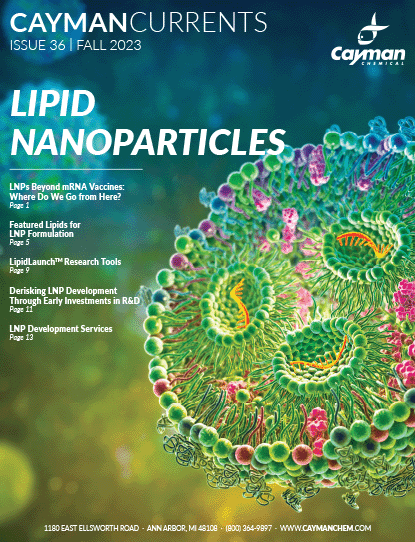

LNPs are primed to revolutionize modern medicine. This technology has immense possibilities to evolve beyond infectious disease to reach targets once considered undruggable and treat a near infinite number of conditions. In this issue of Cayman Currents, we showcase the ongoing discoveries and innovation advancing LNPs to the forefront of modern medicine and highlight tools available from Cayman to support LNP research. 

Articles: 
Download Copy (PDF)
lnp current

​Cayman Currents Issue 35: Long COVID: Biomarker and Therapeutic Discovery

Cayman Currents


COVID-19 symptoms can persist in an estimated 10% of patients long past recovering from the worst impacts of acute infection and testing negative for SARS-CoV-2. Inconsistencies in symptoms, patient phenotypes, and risk factors make it difficult to pinpoint the exact cause of Long COVID. In this issue of Cayman Currents, explore prominent theories of underlying pathophysiology, lessons from other post-viral syndromes, and Cayman’s products and services to accelerate Long COVID research.

Article:

Download Copy (PDF)

​​Cayman Currents Issue 34: Phytocannabinoids: What Is on the Horizon?

Cayman Currents


As Δ9-THC remains a controlled substance in almost all countries, new avenues are opening for the other non-regulated Cannabis constituents. Much is still left to be uncovered in knowing how Cannabis stimulates the endocannabinoid system in the body and to substantiate its anecdotal and scientific merits as a potential therapeutic. Cayman continues to keep an eye on the horizon by supporting law enforcement agencies in the quick identification of illicit synthetic cannabinoids, legal Cannabis industry purveyors in the safe manufacture of their products, and basic science researchers in the pursuit of understanding the endocannabinoid system and how it is affected by Cannabis.

Articles:

Note: Since the printing of this issue, we have updated the article ​"International Regulation and Control of Hemp and Cannabinoids" and the phytocannabinoid reference table in our digital version.
Download Copy (PDF)

​Cayman Currents Issue 33: Antiviral Strategies for Emerging Infectious Diseases

Cayman Currents


The pandemic caused by the unexpected emergence of severe acute respiratory syndrome coronavirus 2 (SARS-CoV-2), the causative agent of COVID-19, has prompted an urgent need for therapeutics and a vaccine against this infectious disease. Explore Cayman's tools to support the needed research to understand emerging infectious diseases in this issue of the Cayman Currents. 

Articles:

Request a physical copy of this issue to receive the special tear-out feature: ​Viral Infection Life Cycle.

Note: Since the printing of this issue, we have updated our depiction of the SARS-CoV-2 virus with the appropriate proteins in our digital version.

Download Copy (PDF)

​Cayman Currents Issue 32: Proven Solutions for Lipid Analysis

Cayman Currents


Mass spectrometry has emerged as the gold standard for the quantitative analysis of bioactive lipids. Important changes have occurred just in the past 25 years, with the emergence of electrospray ionization (ESI) and remarkable developments in tandem mass spectrometry, including tandem quadrupole mass spectrometer systems and ion trap-based mass analyzers. This issue highlights advances in mass spectrometry and insights from experts in the field.

Articles: 

Download Copy (PDF)

Cayman Currents Issue 31: Fatty Liver Disease (NAFLD/NASH)

Cayman Currents


The obesity epidemic has resulted in a dramatic escalation in the number of individuals with hepatic fat accumulation or steatosis. When not combined with excessive alcohol consumption, the broad term for this spectrum of disease is referred to as non-alcoholic fatty liver disease (NAFLD). A significant proportion of individuals with simple steatosis will progress to the severe form of the disease known as non-alcoholic steatohepatitis (NASH), involving hepatocyte damage, inflammation, and fibrosis. If left untreated, NASH can lead to more severe forms of liver disease such as cirrhosis, hepatocellular carcinoma, liver failure, and eventually necessitate liver transplantation.

Article:

Request a physical copy of this issue to receive the special tear-out feature: Targeting PPARs: A guide to function and structure.
Download Copy (PDF)

​Cayman Currents Issue 30: Ferroptosis: A New Form of Cell Death

Cayman Currents


Ferroptosis is one of the more recently described forms of non-apoptotic cell death. This is an oxidative, iron-dependent process with cell death resulting from the accumulation of lipid reactive oxygen species (ROS) to toxic levels. Unlike apoptosis and other forms of non-apoptotic cell death, there is no evidence to date that the execution of ferroptosis requires one specific effector protein (e.g., a pore-forming protein). Rather, this lethal process is centered on the iron-dependent, oxidative destruction of membrane lipids.

Download Copy (PDF)

Cayman Currents Issue 29: Innate Immune Signaling: cGAS/STING

Cayman Currents


Innate immunity is a key pathway activated in response to bacterial and viral infections. The invasion of foreign nucleic acids results in the production of interferons and cytokines that comprise the host defense. More recently, roles for innate immunity in tumorigenesis, autoimmune disease, and senescence also have been elucidated. In these diseases, it is ‘self’ nucleic acids, RNA and DNA, which escape into the cytosol and trigger immune responses. Cyclic GMP-AMP synthase (cGAS) and stimulator of interferon genes (STING) are the key sensors of nucleic acids in the immunity pathway.

Download Copy (PDF)

​Cayman Currents Issue 28: Fentanyl Identification

Cayman Currents


Fentanyl is a powerful synthetic opioid developed by Janssen Pharmaceutica in 1959 that has roughly one hundred times the potency of morphine. Due to fentanyl’s powerful analgesic properties and wide therapeutic index, it has been safely used by the medical community for decades.

Articles: 

To cite this Cayman Currents issue: Cayman Chemical. Fentanyl Identification Cayman Currents. 28, Ann Arbor (2017).
Download Copy (PDF)

​Cayman Currents Issue 27: Epigenetics

Cayman Currents


A key concept in the field of epigenetics is the generation of persistent changes in gene expression without changing DNA sequence. These persistent changes involve groups of genes regulated in a coordinated manner, resulting in shifts in the ‘epigenetic landscape,’ first proposed by Conrad Waddington in the 1940s.

Download Copy (PDF)

​Cayman Currents Issue 22.1: Neutrophil Biology

Cayman Currents


Neutrophils have been recognized for their role in the engulfment and destruction of invasive pathogenic microorganisms for more than a century. The critical role played by neutrophils in immune defense is underscored by the severity of diseases resulting from neutrophil absence or dysfunction, including Chronic Granulomatous Disease (CGD) and Leukocyte Adhesion Deficiency (LAD).

Download Copy (PDF)

​Cayman Currents Issue 26: Forensic Chemistry: Cannabinoid Degradants

Cayman Currents


Synthetic cannabinoids were originally designed and synthesized as molecular probes to characterize structure-activity relationships and to elucidate the biological basis and pharmacological properties of the chemical constituents in Cannabis.

Download Copy (PDF)

​Cayman Currents Issue 20: Epigenetics 

Cayman Currents


Epigenetics is an amazingly complex and fascinating area of research that captures the interest of scientists worldwide as well as many scientists here at Cayman Chemical. “Epigenetics” most simply and broadly means ‘above the genome’ (epi in Greek meaning over, above). In an almost equally broad sense, it refers to the study of heritable changes in gene activity that are not caused by changes in DNA sequence.

Article:
Download Copy (PDF)
Displaying 1 - 14 of 14 Results

