
News & Announcements
Lipid-Based Nano Drug Delivery
Article from 2021-05-20
Lipid-based formulations have contributed to significant achievements in drug development and the delivery of therapeutic biomolecules and genes. Their design can help overcome the biodistribution and/or bioavailability limitations of certain conventional drug delivery methods by enabling cell-specific targeting and transport to specific organelles and prolonging the stability of the drug. Lipid-based nanoparticles can be used to package drugs for topical, oral, intravenous, or pulmonary routes of administration. The first FDA-approved, lipid-based drug formulation, Doxil®, an antitumor antibiotic, became available in 1995. Since then, seventeen additional FDA-approved therapeutics are on the market for use in cancer, gene therapy, antiviral vaccines, fungal diseases, analgesia, and photodynamic therapy. Hundreds more are in clinical trials or even authorized for emergency use—as is the case for the Pfizer and Moderna COVID-19 vaccines. Indeed, the most progress has been made in the field of nucleic acid delivery, involving the encapsulation of short interfering RNA (siRNA), microRNA (miRNA), short activating RNA (saRNA), or messenger RNA (mRNA) in a lipid nanoparticle for gene silencing or activation and protein production.
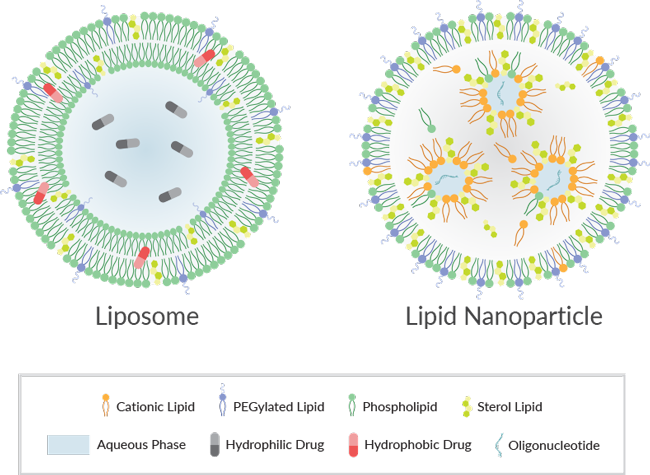
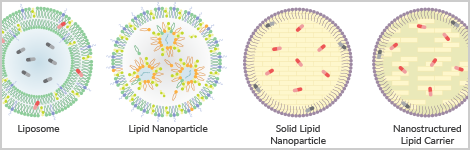
Traditional liposomes are characterized by a lipid bilayer surrounding an aqueous core. Lipid nanoparticles possess an electron-dense core, where the ionizable cationic lipids are organized into inverted micelles around the encapsulated genetic material.
Advantages of Lipid-Based Nanoparticles
Lipid-based nanoparticles are spherical vesicles—possessing at least one lipid bilayer with at least one internal aqueous compartment—that carry and deliver a compound in a solubilized state at a uniform dose. Hydrophobic drugs have affinity to the lipid bilayer, and hydrophilic drugs are contained in the aqueous space. The protection offered by this delivery mechanism boosts the bioavailability of therapeutic compounds by controlling solubility, permeability, absorption, distribution, and metabolism. These nanoparticles often include surface modifications, such as the addition of ligands or polymers, to extend their circulation and enhance delivery. Through passive targeting, this delivery system can improve the toxicity profile of a drug, enhancing its therapeutic index compared to conventional formulations. Furthermore, lipid-based nanoparticles enable delivery of more difficult-to-administer therapeutics, like RNA, that are prone to instability, nuclease-mediated degradation, strong immune responses, or have obstacles in reaching the site of action.
Lipid-Based Nanoparticle Classes
Liposomes form a large subset of lipid-based nanoparticles and are composed of phospholipids or synthetic amphiphiles intercalated with sterols like cholesterol to influence membrane structure, stability, permeability, and membrane fusion. They can form unilamellar and multilamellar structures. Another subset similar to liposomes are lipid nanoparticles (LNPs), which are widely used for nucleic acid delivery. They primarily differ from liposomes through their formation of micellar structures within the particle core. Vesicles composed of sphingomyelin and cholesterol called optisomes or sphingosomes have also been specifically developed to contain certain drugs, as have virosomes, which contain inactivated viral proteins intercalated in the phospholipid bilayer and can be adjuvanted for vaccine delivery to facilitate distribution of a viral antigen to immune cells.
Lipid-Based Nanoparticle Structural Components
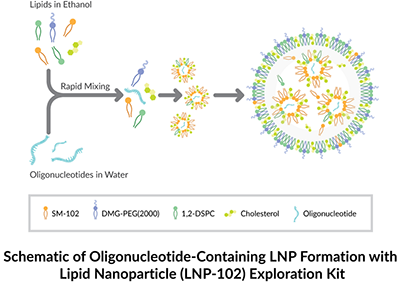
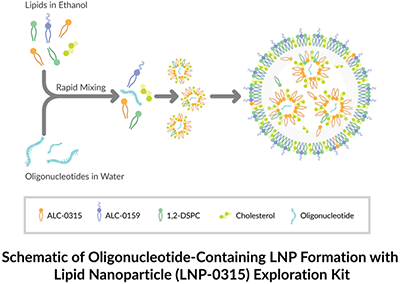
The method used to prepare lipid-based nanoparticles is critical to determining the size and encapsulation efficacy of the vesicles. The lipid components are dissolved in an organic solvent in defined ratios, while the cargo portion is dissolved in an aqueous solution. These two solvents are combined, whereupon the vesicles self-assemble and can be filtered to a desired size. A variety of factors go into determining which combinations of lipids, cosolvents, and surfactants are selected. These formulation variations determine the size, composition, charge, thermal transition, permeability, and lamellarity of the liposome. Strands of polymers such as polyethylene glycol (PEG) can be incorporated into the system through PEGylation to improve the therapeutic index. For example, a PEG covalently linked to a liposome can reduce immunogenicity and antigenicity, protecting it from the recipient's macrophage system trained to destroy foreign substances. The addition of PEG can also alter physiochemical properties to reduce renal clearance and prolong time in circulation, lowering dosage frequency. The addition of an ionizable cationic lipid enables interactions with negatively charged contents like genetic material or negatively charged cell membrane components or with specific proteins exposed at the cell membrane of the target cell. Conversely, the introduction of anionic lipids facilitates interactions with positively charged contents. The inclusion of thermosensitive lipids enables temperature-dependent release of an encapsulated compound. LNPs are typically composed of cationic or ionizable lipids, phospholipids, cholesterol, and PEGylated lipids. Ionizable LNPs are well suited to deliver nucleic acid therapies as they have a near-neutral charge at physiological pH but become charged in acidic endosomal compartments, promoting endosomal escape for intracellular delivery.
Available from Cayman
Lipid-based nanoparticles designed for drug delivery show great potential in overcoming the limitations of conventionally formulated drugs, enhancing their therapeutic efficacy. From an early perspective in drug design, the ingredients found in these lipid formulations must meet regulatory requirements, undergoing extensive safety and toxicity profiling before introduction into clinical trials. Cayman supports these preclinical drug development programs by offering the below research tools as well as contract services for custom lipid synthesis. Contact us to learn more.
Anionic Lipids
Dihexadecyl Phosphate
Phosphatidylinositols (plant, wheat germ) (sodium salt)
Phosphatidylinositols (soy) (sodium salt)
Phosphatidic Acids (PAs)
Phosphatidic Acids (egg) (ammonium salt)
1,2-Dimyristoyl-sn-glycero-3-phosphate (sodium salt) (DMPA)
1,2-Dioleoyl-sn-glycero-3-PA (ammonium salt) (DOPA)
1,2-Dipalmitoyl-sn-glycero-3-phosphate (sodium salt) (DPPA)
1-Oleoyl Lysophosphatidic Acid (Lyso-PA)Phosphoserines (PSs)
Phosphatidylserines (bovine)
Phosphatidylserines (soy) (sodium salt)
1,2-Dimyristoyl-sn-glycero-3-PS (sodium salt) (DMPS)
1,2-Dioleoyl-sn-glycero-3-PS (sodium salt) (DOPS)
1,2-Dipalmitoyl-sn-glycero-3-PS (sodium salt) (DPPS)Phosphoglycerols (PGs)
1,2-Dilauroyl-sn-glycero-3-PG (sodium salt) (DLPG)
1,2-Dimyristoyl-sn-glycero-3-PG (sodium salt) (DMPG)
1,2-Dioleoyl-sn-glycero-3-PG (sodium salt) (DOPG)
1,2-Dipalmitoyl-sn-glycero-3-PG (sodium salt) (DPPG)
1-Palmitoyl-2-oleoyl-sn-glycero-3-PG (sodium salt) (POPG)Lysophosphoglycerols (Lyso-PGs)
1-Myristoyl-2-hydroxy-sn-glycero-3-PG (sodium salt) (14:0 Lyso-PG)
1-Palmitoyl-2-hydroxy-sn-glycero-3-PG (sodium salt) (16:0 Lyso-PG)
1-Stearoyl-2-hydroxy-sn-glycero-3-PG (sodium salt) (18:0 Lyso-PG)
1-Oleoyl-2-hydroxy-sn-glycero-3-PG (sodium salt) (18:1 Lyso-PG)
See all Anionic Lipids
Cationic Lipids
1,2-Dioleoyl-3-trimethylammoniumpropane (chloride) (DOTAP)
SM-102
Glycerolipids
1,2,3-Tridocosanoyl Glycerol
1,2,3-Trilauroyl Glycerol
1,2,3-Tripalmitoyl Glycerol
1,2,3-Tristearoyl Glycerol
See all Glycerolipids
Neutral Phospholipids
Phosphocholines (PCs)
1,2-Dilauroyl-sn-glycero-3-PC (DLPC)
1,2-Dimyristoyl-sn-glycero-3-PC (DMPC)
1,2-Dioleoyl-sn-glycero-3-PC (DOPC)
1,2-Dipalmitoyl-sn-glycero-3-PC (DPPC)
1,2-Distearoyl-sn-glycero-3-PC (DSPC)
1,2-Diphytanoyl-sn-glycero-3-PC (DPhPC)
1,2-Diheptadecanoyl-sn-glycero-3-PC (PC(17:0/17:0))
Lysophosphocholines (Lyso-PCs)
1-Linoleoyl-2-Hydroxy-sn-glycero-3-PC (Lyso-PC)
1-Palmitoyl-2-hydroxy-sn-glycero-3-PC (16:0 Lyso-PC)
1-Stearoyl-2-hydroxy-sn-glycero-3-PC (18:0 Lyso-PC)Phosphoethanolamines (PEs)
1,2-Dimyristoyl-sn-glycero-3-PE (DMPE)
1,2-Dioleoyl-sn-glycero-3-PE (DOPE)
1,3-Dipalmitoyl Glycero-2-PE (DPPE)Lysophosphoethanolamines (Lyso-PEs)
Lysophosphatidylethanolamines (egg) (Lyso-PE)
1-Myristoyl-2-hydroxy-sn-glycero-3-PE (14:0 Lyso-PE)
1-Stearoyl-2-hydroxy-sn-glycero-3-PE (18:0 Lyso-PE)
See all Neutral Phospholipids
PEGylated Lipids
DSPE-MPEG(2000) (sodium salt)
DMG-PEG(2000)
DSPE-PEG(2000)-amine
See all PEGylated Lipids
Sphingolipids
Sphingomyelins (buttermilk)
C16 Sphingomyelin (d18:1/16:0)
D-erythro Lysosphingomyelin (d18:1)
See all Sphingolipids
Sterol Lipids
Cholesterol
Cholesteryl Myristate
Cho-Arg (trifluoroacetate salt)
2H-Cho-Arg (trifluoroacetate salt)
DC-Chol (hydrochloride)
DMHAPC-Chol
DMPAC-Chol
Dios-Arg (trifluoroacetate salt)
HAPC-Chol
OH-C-Chol
MHAPC-Chol
See all Sterol Lipids
REQUEST CUSTOM SYNTHESIS OF HIGH-PURITY LIPID COMPONENTS
Unsure where to start? Discover our Lipid Nanoparticle Exploration Kits designed for labs starting out with LNPs. Our Technical Support scientists are also here to help answer your research questions.
Lipid Nanoparticle Exploration KitsIntended to serve as a starting point for laboratories to explore the feasibility of using LNPs for their individual application without the need for specialized equipment.
|
You May Also Be Interested In
 Discover the Latest LNP Research Tools & Resources Discover the Latest LNP Research Tools & Resources | |
 The Heads and Tails of Lipid-Based Drug Delivery |  Lipid Nanoparticle Research Tools |
Explore more products, services, literature, and tools from Cayman at our Lipid Resource Center
Suggested Reading
Bulbake, U., Doppalapudi, S., Kommineni, N., et al. Liposomal formulations in clinical use: An updated review. Pharmaceutics. 9(2), 12 (2017).
Guevara, M.L., Persano, F., and Persano, S. Advances in lipid nanoparticles for mRNA-based cancer immunotherapy. Front. Chem. 8, 589959 (2020).
Kester, M., Bassler, J., Fox, T.E., et al. Preclinical development of a C6-ceramide NanoLiposome, a novel sphingolipid therapeutic. Biol. Chem. 396(6-7), 737-747 (2015).
Mirzavi, F., Barati, M., Soleimani, A., et al. A review on liposome-based therapeutic approaches against malignant melanoma. Int. J. Pharm. 599, 120413 (2021).
Mitchell, M.J., Billingsley, M.M., Haley, R.M., et al. Engineering precision nanoparticles for drug delivery. Nat. Rev. Drug Discov. 20(2), 101-124 (2021).
Contact Info
Cayman Chemical1180 East Ellsworth RoadAnn Arbor, Michigan 48108 USAToll Free: (800) 364-9897(USA and Canada only)Fax: (734) 971-3640


