
News & Announcements
Research Tools for Fatty Liver Diseases
Research Tools for Fatty Liver Diseases
Article from 2017-03-22
Fatty liver diseases have recently been renamed to better reflect the underlying metabolic origins of these diseases. Non-alcoholic fatty liver disease (NAFLD) was renamed to metabolic dysfunction-associated steatotic liver disease (MASLD), and non-alcoholic steatohepatitis was renamed to metabolic dysfunction-associated steatohepatitis (MASH).
This article, published in 2017, highlights research tools to study this group of conditions using nomenclature that was standard at the time.
Our latest articles, published in 2024, explore strategies to address the metabolic dysregulation underlying these conditions using the newly accepted terminology.
 | Advancing MASLD & MASH Research: Tools & Strategies for Metabolic Dysfunction in Steatotic Liver Diseases Learn More |
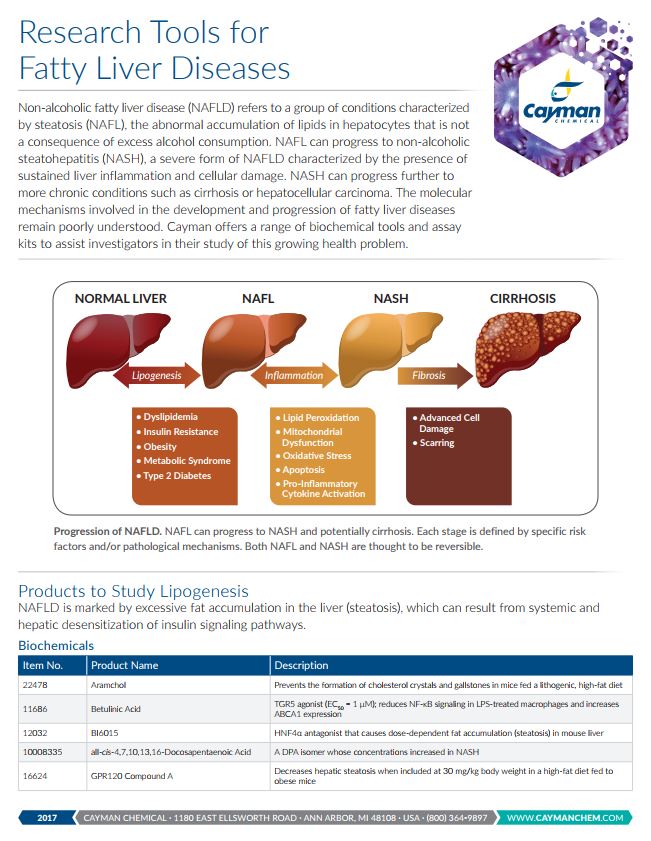
Non-alcoholic fatty liver disease (NAFLD) refers to a group of conditions characterized by steatosis (NAFL), the abnormal accumulation of lipids in hepatocytes that is not a consequence of excess alcohol consumption. NAFL can progress to non-alcoholic steatohepatitis (NASH), a severe form of NAFLD characterized by the presence of sustained liver inflammation and cellular damage. NASH can progress further to more chronic conditions such as cirrhosis or hepatocellular carcinoma. The molecular mechanisms involved in the development and progression of fatty liver diseases remain poorly understood. Cayman offers a range of biochemical tools and assay kits to assist investigators in their study of this growing health problem.
View All Products For NAFLD & NASH
Discover Research Tools for...
Progression of NAFLD.
NAFL can progress to NASH and potentially cirrhosis. Each stage is defined by specific risk factors and/or pathological mechanisms.
Both NAFL and NASH are thought to be reversible.
Products to Study Lipogenesis
NAFLD is marked by excessive fat accumulation in the liver (steatosis), which can result from systemic and hepatic desensitization of insulin signaling pathways.
| Item No. | Product Name | Description |
|---|---|---|
| 22478 | Aramchol | Prevents the formation of cholesterol crystals and gallstones in mice fed a lithogenic, high-fat diet |
| 11686 | Betulinic Acid | TGR5 agonist (EC50 = 1 µM); reduces NF-κB signaling in LPS-treated macrophages and increases ABCA1 expression |
| 12032 | BI6015 | HNF4α antagonist that causes dose-dependent fat accumulation (steatosis) in mouse liver |
| 10008335 | all-cis-4,7,10,13,16-Docosapentaenoic Acid | A DPA isomer whose concentrations increased in NASH |
| 16624 | GPR120 Compound A | Decreases hepatic steatosis when included at 30 mg/kg body weight in a high-fat diet fed to obese mice |
| 17678 | INT-777 | TGR5 agonist (EC50 = 0.82 µM); reduces hepatic steatosis and adiposity in mice subjected to dietinduced obesity |
| 22287 | Ipragliflozin | A potent inhibitor of sodium-glucose cotransporter 2 (SGLT2; IC50 = 7.4 nM for human SGLT2 in vitro) |
| 13118 | Metformin (hydrochloride) | Improves fatty liver disease by reversing hepatic steatosis in ob/ob mice |
| 18293 | MHY908 | Improves hepatic steatosis by enhancing CPT1 levels and reducing ER stress and JNK activation in livers of db/db mice |
| 15192 | ML-261 | Inhibits hepatic lipid droplet formation (IC50 = 69.7 nM in mouse AML-12 hepatocytes) |
| 10007853 | Muraglitazar | A dual agonist of PPARα and PPARγ that improves diabetes and other metabolic abnormalities while preserving β-cell function in db/db mice |
| 14173 | Naringenin | Corrects VLDL overproduction, ameliorates hepatic steatosis, and attenuates dyslipidemia in LDL receptor-deficient mice fed a Western diet |
| 17118 | Niclosamide (ethanolamine salt) | Prevents high-fat diet-induced hepatic steatosis in db/db mice |
| 16209 | p-nitro-Pifithrin-α | Attenuates steatosis and liver injury in mice fed a high-fat diet |
| 71745 | Pioglitazone | A selective PPARγ-1 agonist with antidiabetic actions (one-tenth as potent as rosiglitazone) |
| 71740 | Rosiglitazone | A potent antidiabetic agent that acts as a selective PPARγ agonist (Kd = 43 nM) |
| 18771 | SR9238 | LXRα and LXRβ inverse agonist (IC50s = 214 and 43 nM, respectively); suppresses hepatic lipogenesis, inflammation, lipid accumulation, and fibrosis in mouse models of NASH |
| 16291 | TGR5 Receptor Agonist | Activator of TGR5 (pEC50 = 6.8-7.5); increases GLP-1 secretion and improves glucose disposal |
| 20275 | Taurochenodeoxycholic Acid (sodium salt) | Significantly increased in patients with liver cirrhosis and may serve as a marker of disease progression |
| 20756 | Deoxycholic Acid | Acts as a detergent in the emulsification of fats for intestinal absorption |
| 15121 | Ursodeoxycholic Acid (sodium salt) | Interferes with transport activity of the sodium taurocholate cotransporting polypeptide (IC50 = 3.6 μM); inhibits apoptosis in liver cells by preventing formation of reactive oxygen species and the translocation of the pro-apoptotic protein Bax from the cytosol to the mitochondria |
| 20289 | Tauro-β-muricholic Acid (sodium salt) | Competitive and reversible antagonist of the farnesoid X receptor (FXR) (IC50 = 40 µM) |
| 21723 | Glycolithocholic Acid | Increased in livers of mice that are fed diets supplemented with ursadeoxycholic acid; decreased in lean mice treated with obestatin |
| 20294 | Hyodeoxycholic Acid | Decreases plasma VLDL and LDL cholesterol and reduces atherosclerosis in mice; serum levels are increased significantly in Crohn’s disease and ulcerative colitis |
| 15935 | Taurodeoxycholic Acid (sodium salt) | Stimulates both the production of bile by the liver and the flow of bile into the duodenum |
| 10006611 | GW 4064 | A selective agonist of FXR (EC50 = 15 nM) |
| 17369 | Fexaramine | An FXR agonist (EC50 = 25 nM) |
| Item No. | Product Name | Description |
|---|---|---|
| 700260 | Alanine Transaminase Colorimetric Activity Assay Kit | Measure ALT activity in serum, plasma, tissue samples, and cell lysates |
| 10007640 | Cholesterol Fluorometric Assay Kit | Quantitation of total cholesterol in plasma or serum |
| 700310 | Free Fatty Acid Fluorometric Assay Kit | Measure FFAs in plasma, serum, and urine |
| 15741 | FXR (human) Reporter Assay Kit | Screen test samples to quantify functional activity, either agonist or antagonist, that they may exert against human FXR |
| 10011125 | LDL Uptake Cell-Based Assay Kit | Measure LDL uptake in cultured cells |
| 500010 | Leptin (human) EIA Kit | Measure leptin in human serum, plasma, and culture supernatant samples Also available:Leptin (mouse/rat) EIA Kit (Item No. 10007609) and Leptin Receptor (human) EIA Kit (Item No. 10007608) |
| 500001 | Lipid Droplets Fluorescence Assay Kit | Detect lipid droplets, cellular organelles that are also referred to as lipid bodies, oil bodies, or adiposomes |
| 10010854 | SREBP-1 Transcription Factor Assay Kit | A sensitive, non-radioactive method of detecting SREBP-1 from whole cell lysates |
| 10012643 | Steatosis Colorimetric Assay Kit | Detect excessive lipid accumulation in cells |
| 601440 | TGR5 (GP-BAR1) Reporter Assay Kit | Screen for TGR5 agonists, antagonists, and modulators |
| 10010303 | Triglyceride Colorimetric Assay Kit | Measure TG levels in plasma, serum, cell lysates, and tissue homogenates |
Products to Study Inflammation
NASH is marked by inflammation of the liver (steatohepatitis), which can result from cytokine dysregulation, oxidative stress, and hepatocyte apoptosis.
| Item No. | Product Name | Description |
|---|---|---|
| 70935 | (−)-Epigallocatechin Gallate | Inhibits cellular oxidation of low-density lipoproteins |
| 14127 | Febuxostat | Inhibits oxidized and reduced forms of xanthine oxidase |
| 10739 | Isoliquiritigenin | Exhibits antioxidant, anti-inflammatory, and antitumor activities, as well as hepatoprotection against steatosis-induced oxidative stress |
| 11948 | MN-001 | Produces antifibrotic and anti-inflammatory activity in models of NASH |
| 16093 | Myrtillin | A natural anthocyanin with antioxidant activity |
| 18720 | Pentoxifylline | Anti-inflammatory activity, inhibiting TNF-α production |
| 70675 | trans-Resveratrol | Phenolic antioxidant with anti-inflammatory activity |
| 18771 | SR9238 | LXRα and LXRβ inverse agonist (IC50s = 214 and 43 nM, respectively); suppresses hepatic lipogenesis, inflammation, lipid accumulation, and fibrosis in mouse models of NASH |
| 10011659 | Trolox | Derivative of vitamin E with potent antioxidant properties |
| 20277 | Tauroursodeoxycholic Acid | Anti-apoptotic activity in a number of neurodegenerative disease models and retinal disorders; has been shown to reduce ER stress associated with elevated glucose levels in diabetes models |
| 20756 | Deoxycholic Acid | Acts as a detergent in the emulsification of fats for intestinal absorption |
| 20253 | Lithocholic Acid | Suppresses apoptosis in pre-malignant colonic epithelium in the presence of a carcinogen; can activate the pregnane X receptor and the vitamin D receptor |
| 15121 | Ursodeoxycholic Acid (sodium salt) | Interferes with transport activity of the sodium taurocholate cotransporting polypeptide (IC50 = 3.6 μM); inhibits apoptosis in liver cells by preventing formation of reactive oxygen species and the translocation of the pro-apoptotic protein Bax from the cytosol to the mitochondria |
| 10072 | Ursolic Acid | Inhibits Na+/K+-ATPase activity (IC50 = 24.7 μM); blocks NF-κB activation in various human cancer cells lines (10-100 μM) |
| 15383 | Calphostin C | Inhibits protein kinase C (PKC) (IC50 = 50 nM versus an IC50 > 50 μM for PKA); inhibits phospholipase D1 and D2 (IC50s = 100 nM); antitumor activity, inhibiting cell growth and promoting apoptosis in HeLa S3 and MCF-7 cells (IC50 values of 0.23 and 0.18 μM, respectively) |
| 11726 | Oleanolic Acid | Anti-inflammatory, anti-hyperlipidemic, and hepatoprotective in vivo effects |
| 20275 | Taurochenodeoxycholic Acid (sodium salt) | Significantly increased in patients with liver cirrhosis and may serve as a marker of disease progression |
| Item No. | Product Name | Description |
|---|---|---|
| 701080 | COX-2 (human) Inhibitor Screening Assay Kit | Complete Drug Discovery Assay for screening COX-2 inhibitors |
| 702000 | COX-2 (ovine) Inhibitor Screening Assay Kit | Complete Drug Discovery Assay for screening COX-2 inhibitors |
| 10011236 | C-Reactive Protein (human) ELISA Kit | Measure CRP from human plasma without prior sample purification |
| 501030 | Interleukin-6 (human) ELISA Kit | Measure IL-6 from human plasma, serum, synovial fluid, and other sample matrices |
| 600610 | Neutrophil Elastase Activity Assay Kit | Measure neutrophil elastase released by neutrophils after various experimental conditions |
| 601290 | ROS Detection Cell-Based Assay Kit (DHE) | Measure superoxide and hydrogen peroxide levels in living cells |
| 10009055 | TBARS Assay Kit | Measure lipid peroxidation in plasma, serum, urine, tissue homogenates, and cell lysates |
| 700870 | TBARS (TCA Method) Assay Kit | Measure lipid peroxidation in plasma, serum, urine, tissue homogenates, and cell lysates; includes TCA precipitation procedure for improved sample processing |
| 589201 | TNF-α (human) ELISA Kit | Measure TNF-α from human plasma, serum, and other sample matrices |
| 500850 | TNF-α (mouse) ELISA Kit | Measure TNF-α from mouse plasma, serum, and other sample matrices |
Products to Study Fibrosis
Cirrhosis is marked by prolonged cell damage and fibrosis, which results from the activation of hepatic stellate cells and the emergence of fibrotic progenitors.
| Item No. | Product Name | Description |
|---|---|---|
| 16018 | Camostat (mesylate) | A protease inhibitor that disrupts the proliferation of stellate cells |
| 10008199 | Linolenic Acid ethyl ester | Stimulates intracellular signaling pathways in hepatic stellate cells |
| 11948 | MN-001 | Produces antifibrotic and anti-inflammatory activity in models of NASH |
| 17278 | Necrox-5 (methanesulfonate) | A necrosis inhibitor that protects cells from carbon tetrachloride-induced liver injury and chronic liver fibrosis in rodent models |
| 19131 | NK 252 | Exhibits antifibrotic effects in a rat model of NASH |
| 13986 | Pirfenidone | Antioxidant, anti-inflammatory, and antifibrotic effects |
| 18771 | SR9238 | LXRα and LXRβ inverse agonist (IC50s = 214 and 43 nM, respectively); suppresses hepatic lipogenesis, inflammation, lipid accumulation, and fibrosis in mouse models of NASH |
| 20275 | Taurochenodeoxycholic Acid (sodium salt) | Significantly increased in patients with liver cirrhosis and may serve as a marker of disease progression |
| 20756 | Deoxycholic Acid | Acts as a detergent in the emulsification of fats for intestinal absorption |
| 15121 | Ursodeoxycholic Acid (sodium salt) | Interferes with transport activity of the sodium taurocholate cotransporting polypeptide (IC50 = 3.6 μM); inhibits apoptosis in liver cells by preventing formation of reactive oxygen species and the translocation of the pro-apoptotic protein Bax from the cytosol to the mitochondria |
| 20275 | Taurochenodeoxycholic Acid (sodium salt) | Serum levels are significantly increased in patients with liver cirrhosis and may serve as a marker of disease progression |
| 10005167 | Genistein | A tyrosine-specific inhibitor of protein kinase activity, blocking the tyrosine-phosphorylation of histone H2B |
| Item No. | Product Name | Description |
|---|---|---|
| 10009547 | FABP1 (human recombinant) | Potential marker of liver injury |
| 10005200 | FABP1 (rat recombinant) | Potential marker of liver injury |
Download the Brochure (PDF)
Contact Info
Cayman Chemical1180 East Ellsworth RoadAnn Arbor, Michigan 48108 USAToll Free: (800) 364-9897(USA and Canada only)Fax: (734) 971-3640


