
Quantitation of 6-PPD-Q and Its Metabolites in Fish Using LC-MS/MS
Featured Application notes
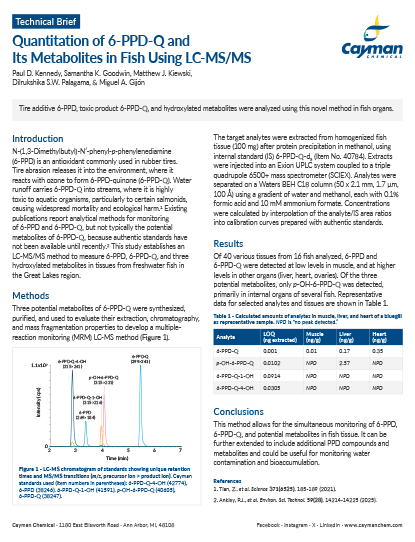
This study establishes a novel LC-MS/MS method to measure tire rubber antioxidant 6-PPD, its toxic oxidized transformation product 6-PPD-Q, and several potential metabolites in fish tissue. This method can be further extended to include additional PPD compounds and metabolites and could be useful for monitoring water contamination and bioaccumulation.
To cite this technical brief: Kennedy, P.D., Goodwin, S.K., Kiewski, M.J., et al. Quantitation of 6-PPD-Q and its metabolites in fish using LC-MS/MS. Technical Brief, Cayman Chemical Company (2026).
Analysis of a Complex Mixture of 13 Benzodiazepines Using HPLC-PDA Detection
Application notes
Outer Membrane Permeabilization via Perfringolysin O Treatment
Application notes
Perfringolysin O (PFOC459A) treatment permeabilizes the outer membrane of live cells, allowing for the investigation of biochemical reactions in whole cells with intact intracellular compartments, including mitochondria.
To cite this technical brief: Foss, M. and Assar, Z. Outer membrane permeabilization via perfringolysin O treatment. Technical Brief, Cayman Chemical Company (2026).
Chromatographic Separation of 7-Hydroxy Mitragynine from Mitragynine Pseudoindoxyl
Application notes
Key Features:
- The co-elution of 7-hydroxy mitragynine (7-HMG; 7-OH) and mitragynine pseudoindoxyl (MP), two important mitragynine-related alkaloids, by traditional GC-MS methods makes testing a challenge for analysts.
- If testing methods are unable to resolve these two substances in casework, identification and quantification can become compromised.
- The rise of consumer products on the drug market containing potent semi-synthetic opioids derived from kratom, such as 7-hydroxy mitragynine and mitragynine pseudoindoxyl, is of great public health and safety concern.
- Several chromatographic methods to achieve separation are explored in this application note. Method information presented herein may be used to assist labs in developing methods to identify and quantify 7-hydroxy mitragynine and mitragynine pseudoindoxyl in seized drug analysis and/or toxicology cases.
Analysis of a Complex Mixture of Orphines Using HPLC-PDA Detection
Application notes
SM-102-based Lipid Nanoparticles as a Benchmark for the Development of Novel Formulations
Application notes
Evaluation of Quantification Capabilities of Untargeted Lipidomics Approaches
Application notes
We evaluated the accuracy of lipid quantitation in human plasma by LC-MS using single-point or multipoint calibration curves with authentic or surrogate standards.
Highlights:
- Both methods identified hundreds of lipids with precision and accuracy.
- Multipoint calibration curves outperformed single-point calibration curves.
- The proper selection of standards is critical for quantitation accuracy.
Characterization of Human Plasma as a Reference Material for Lipid Analysis Using LC-MS
Application notes
Key Features
- A preparation of human plasma has been characterized as a reference material for lipid identification and quantitation using LC-MS.
- The validity of the methods used and the values obtained is supported by the reasonable agreement with published values in NIST SRM 1950 plasma.
- MaxSpec® Reference Plasma (Human) can be used for quality control, method development, and performance validation in lipid studies.
- A list of lipid concentrations is made public and periodically updated.
To cite this application note: Kwiatkowski, M.J., Goodwin, S.K., DeLoy, S.L., et al. Characterization of human plasma as a reference material for lipid analysis using LC-MS. Application Note, Cayman Chemical Company (2025).
Creating Custom Cannabis CRM Mixtures: Forty-seven Phytocannabinoids, One HPLC Method
Application notes
- Chromatography was run on 47 phytocannabinoid compounds (12 acid and 35 neutral).
- Co-eluting neutral compounds were identified and segregated for the acceptable validation of an HPLC method.
- This method supports Cayman’s quick turn production of custom phytocannabinoid CRMs.
To cite this application note: Franckowski, R., Gregerson, M., Calati, K., et al. Creating Custom Cannabis CRM Mixtures: Forty-seven Phytocannabinoids, One HPLC Method. Application Note, Cayman Chemical (2025).
Analysis of Complex Mixtures of Octadecanoid Isomers by LC–MS/MS
Application notes
Octadecanoids, oxylipins derived from linoleic or linolenic acids, are being increasingly recognized as having important effects in biological responses. Here we show how authentic standards of several isomeric octadecanoids facilitate the establishment of LC–MS/MS method for the detection and quantitation of epoxyoctadecadienoic acids (EpODEs) and dihydroxyoctadecadienoic acids (DiHODEs) in rat plasma.
To cite this application note: DeLoy, S., Dittmer, J., LaGory, D., et al. Analysis of Complex Mixtures of Octadecanoid Isomers by LC–MS/MS. Application Note, Cayman Chemical (2025).
Biodistribution Assessment of Lipid Nanoparticle-Mediated mRNA Delivery Using In Vivo Imaging
Application notes
Key Features
- Cayman’s LNP development services in partnership with Labcorp utilizes in vivo imaging technology to create a comprehensive LNP screening platform.
- With this approach, three LNP formulations were assessed in vitro and in vivo for potency of reporter gene expression and differential organ delivery.
- This comprehensive LNP formulation, characterization, and analysis service can be used to identify candidate LNP formulations with tissue-tropic distribution.
mRNA Delivery to Activated Primary Human T Cells Using C14-4 Lipid Nanoparticles
Application notes
Key Features
- Primary immune cells, especially T cells, are challenging to transfect due to their natural resistance to foreign genetic material.
- Lipid nanoparticles (LNPs) offer improved efficiency with reduced cytotoxicity compared with traditional transfection methods.
- This workflow can be used with LNPs for the delivery of mRNA to achieve optimal protein expression in activated primary human T cells.
The Naveni® Technology
Application notes
To cite this application note: The Naveni® Technology: A Trusted Neuroscience Tool. Application Note, Navinci Diagnostics (2024).
GC Separation of ADB-BUTINACA from its Precursor ADB-INACA
Application notes
Key Features
- Coelution of ADB-BUTINACA and its synthetic precursor ADB-INACA makes traditional GC-MS methods difficult for the quantification of these two novel psychoactive substances (NPS). Quantities of these synthetic cannabinoids are distorted if the testing methods are unable to resolve the two substances in analyzed samples.
- A new GC method for the separation of ADB-BUTINACA from its precursor ADB-INACA offers a reliable and robust solution for identifying this DEA Schedule I compound.
To cite this application note: Pierzynski, H.G., Liu, J., Calati, K.B., et al. GC separation of ADB-BUTINACA from its precursor ADB-INACA. Application Note, Cayman Chemical (2024).
Encapsulation and Transfection of RNA Using LipidLaunch™ SM-102 Lipid Nanoparticles (Loadable)
Application notes
Key Features
- Cayman’s LipidLaunch™ SM-102 LNP Kit (Loadable) is comprised of lyophilized SM-102-based lipid nanoparticles (LNPs) prepared without cargo.
- Allows researchers to encapsulate RNA cargo of choice for LNP-mediated transfection without microfluidic mixing devices.
- Enable RNA delivery to difficult-to-transfect cell lines and primary cultures.
- LipidLaunch™ SM-102 LNPs (Loadable) facilitate effective RNA transfection with minimal cytotoxicity compared to traditional transfection reagents.
Quantification of Cyclic Dinucleotides During Growth Phase in Three Bacterial Species Using ELISAs
Application notes
Key Features
- Measurement of 3’3’-cGAMP, cyclic di-GMP, and cyclic di-AMP in bacteria samples using Cayman’s ELISAs.
- ELISA data provides accurate and reliable results over a wide range of dilutions.
- Bacterial cyclic dinucleotides (CDNs) can be measured in growth media and supernatants by ELISA without a cumbersome organic extraction.
- Bacterial supernatants contain significantly higher levels of CDNs compared to corresponding lysates.
- Different bacteria species show unique CDN profiles during growth phase in both lysates and supernatants.
- ELISAs provide a user-friendly and cost-effective method to quantify CDN concentrations in bacteria supernatants to better understand the role these second messengers play.
To cite this application note: Metcalfe, K.C., Blaylock, J.B., Sule, G.J., et al. Quantification of Cyclic Dinucleotides During Growth Phase in Three Bacterial Species Using ELISAs. Application Note, Cayman Chemical (2023).
Ionizable Lipid Composition Influences Lipid Nanoparticle Efficacy in Multiple Cell Types In Vitro
Application notes
Key Features
- Cell lines derived from different tissues have distinct reporter expression patterns in response to a variety of lipid nanoparticles (LNPs).
- Serum requirement for LNP uptake and cargo expression in vitro vary with cell type and ionizable lipid.
- Experimental design is of utmost importance in assessing the efficacy of any given LNP preparation.
GC Separation for Identification of iso-THC Contaminants and Accurate Quantification of Δ8 -THC and Δ9-THC in Cannabis Samples
Application notes
Key Features
- Synthetic conversion of cannabidiol (CBD) to the tetrahydrocannabinols (THCs) Δ9-THC and Δ8 -THC produces measurable quantities of the iso-THC products Δ8-iso-THC and Δ4(8)-iso-THC.
- Co-elution of THCs and iso-THCs makes C18 reversed phase-HPLC (RP-HPLC) methods unsuitable for the quantification of THCs. Quantities of THCs are distorted if the testing methods are unable to resolve the iso-THCs in analyzed samples.
- Gas chromatography (GC) offers a reliable and robust method for quantification of Δ9-THC, Δ8-THC, Δ8-iso-THC, and Δ4(8)-iso-THC. Additionally, this method represents a method for identifying THC derived from CBD conversion.
To cite this application note: Williams, J.B., Liu, J., and Hering, K.W. GC separation for identification of iso-THC contaminants and accurate quantification of Δ8-THC and Δ9-THC in Cannabis samples. Application Note, Cayman Chemical (2023).
Discovery of Potential Soluble Epoxide Hydrolase Inhibitors Using a High-throughput Screening Assay on a 235 Compound Library
Application notes
Key Features
- Soluble epoxide hydrolase (sEH) inhibitors are a promising strategy for the treatment of inflammatory and cardiovascular conditions.
- We have developed an automated high-throughput screening (HTS) platform to identify small molecule inhibitors that enables testing of a large number of compounds in days instead of weeks using minimal sample volumes.
- We screened all 235 compounds in Cayman’s Anti-Inflammatory Screening Library and identified 36 compounds as potential sEH inhibitors using this approach.
- This HTS platform accelerates drug discovery. It can be adapted to many other enzyme activity assays and performed using Cayman or client-provided compound libraries.
To cite this application note: Contract Services Screening Group. Discovery of Potential Soluble Epoxide Hydrolase Inhibitors Using a High-throughput Screening Assay on a 235 Compound Library. Application Note, Cayman Chemical (2022).
HPLC Method to Differentiate Four THC Stereoisomers Formed from Δ9-THC Degradation: (6aR,9R)-Δ10-THC, (6aR,9S)-Δ10-THC, 9(R)-Δ6a,10a-THC, and 9(S)-Δ6a,10a-THC
Application notes
Key Features
- Δ10-THC and Δ6a,10a-THC isomers produced from Δ9-THC degradation have stereochemical similarities that are challenging to differentiate.
- Traditional reversed-phase (C18) HPLC analysis is not suitable for accurate determination of these isomers.
- A method using a chiral HPLC column under normal-phase conditions offers reliable and robust identification of the four stereoisomers.
- Use of a chiral HPLC stationary phase for characterization of these phytocannabinoid degradants is an essential tool for the determination of potency and safety.
To cite this application note: Williams, J.B., Calati, K.B., Hering, K.W., et al., HPLC method to differentiate four THC stereoisomers formed from Δ9-THC degradation: (6aR,9R)-Δ10-THC, (6aR,9S)-Δ10-THC, 9(R)-Δ6a,10a-THC, and 9(S)-Δ6a,10a-THC. Application Note, Cayman Chemical (2021).
MACSQuant® Analyzer X Calcium flux assay in mixed populations using kinetic flow
Application notes
Key Information
- Kinetic flow cytometry is an ideal approach to run a calcium flux assay on a mixed cell
- Cayman’s reagents thapsigargin and fluo-3 AM can be used with Miltenyi Biotec’s recombinant antibodies and MACSQuant X Flow Cytometer to test calcium flux in multiple cell types
- This simple approach can be applied to many complex cell mixes, from peripheral blood mononuclear cells (PBMCs) to transfected cells or dissociated
To cite this application note: Nyayapathy, S., Rumble, J.M. Calcium flux assay in mixed populations using kinetic flow cytometry. Application Note, Cayman Chemical (2021).
High-Throughput Flow Cytometric Screening of a Kinase Inhibitor Library for Apoptosis Induction
Application notes
Key Information
- Cayman’s multiparametric Early Apoptosis Detection Assay Kit used with Miltenyi Biotec’s MACSQuant® X Flow Cytometer creates a powerful, efficient, and exquisitely detailed screening tool.
- Using this approach to screen a library of kinase inhibitors for cytotoxicity, apoptosis inducers were distinguished from necrosis-causing or mitochondrial-uncoupling compounds.
- This simple approach can be adapted to many other probes for cellular function to help determine the effects of potential therapeutic compounds during the drug development process.
To cite this application note: Rumble, J.M., Hoffman, D.L. High-Throughput Flow Cytometric Screening of a Kinase Inhibitor Library for Apoptosis Induction. Application Note, Cayman Chemical (2020).
Seropositivity Testing for SARS-CoV-2 Neutralizing Antibodies
Application notes
Key Features
- The detection of SARS-CoV-2 neutralizing antibodies offers important information for evaluating immune responses to COVID-19. It has multiple applications such as studies of herd immunity and vaccine development among others.
- Cayman’s SARS-CoV-2 Neutralizing Antibody Detection ELISA Kit functions as both a simple, qualitative indicator of positive or negative samples and as a semi-quantitative indicator of seropositivity.
- Disease-free positive and negative plasma controls are supplied to confirm the assay is performing as expected.
- Approximating concentrations of neutralizing antibody found in positive samples is achieved using a neutralizing antibody as a reference standard.
- The format of our ELISA (in which neutralizing antibodies must recognize the SARS-CoV-2 spike receptor binding domain to inhibit ACE2 binding) provides an efficient and effective screening tool for determining functional antibody neutralization capabilities.
- The semi-quantitative design is the first of its kind for SARS-CoV-2 seropositivity testing and provides a consistent reference point for neutralizing antibody levels not readily available with standard serological assays.
To cite this application note: Tew, D.J., Blaylock, J.B., and Metcalfe, K.C. Seropositivity Testing for SARS-CoV-2 Neutralizing Antibodies. Application Note, Cayman Chemical (2020).
Comparison of CRM Concentrations Among Four Different Reference Material Producers
Application notes
Key Features
- ISO-certified CRMs from multiple manufacturers are employed by analytical facilities to identify Cannabis components and report potency values.
- Reference material consistency across vendors is needed to ensure accuracy of reporting.
- We compare the reported concentration of 11 individual cannabinoid CRMs from four different reference material producers.
- No significant variability in CRM concentrations exists among products produced under the ISO 17034 standard, reaffirming the competence of manufacturers.
To cite this application note: Goodwin, S.K., Franckowski, R.E., and Edwardsen, J.T. Comparison of CRM Concentrations Among Four Different Reference Material Producers. Application Note, Cayman Chemical (2020).
Mitochondrial Fuel Flexibility Assessment in a Tumor-Relevant Model
Application notes
Highlights:
- Examines metabolic flexibility of cancer cells and human MDSCs in a simulated tumor microenvironment
- Demonstrates the power of combining Seahorse XFe96 technology with manipulation of the major mitochondrial fuel pathways
Contact Info
Cayman Chemical1180 East Ellsworth RoadAnn Arbor, Michigan 48108 USAToll Free: (800) 364-9897(USA and Canada only)Fax: (734) 971-3640


