
Development of an LC-MS/MS Method for the Quantitation of 6-PPD-Q and Its Metabolites in Fish
Scientific posters
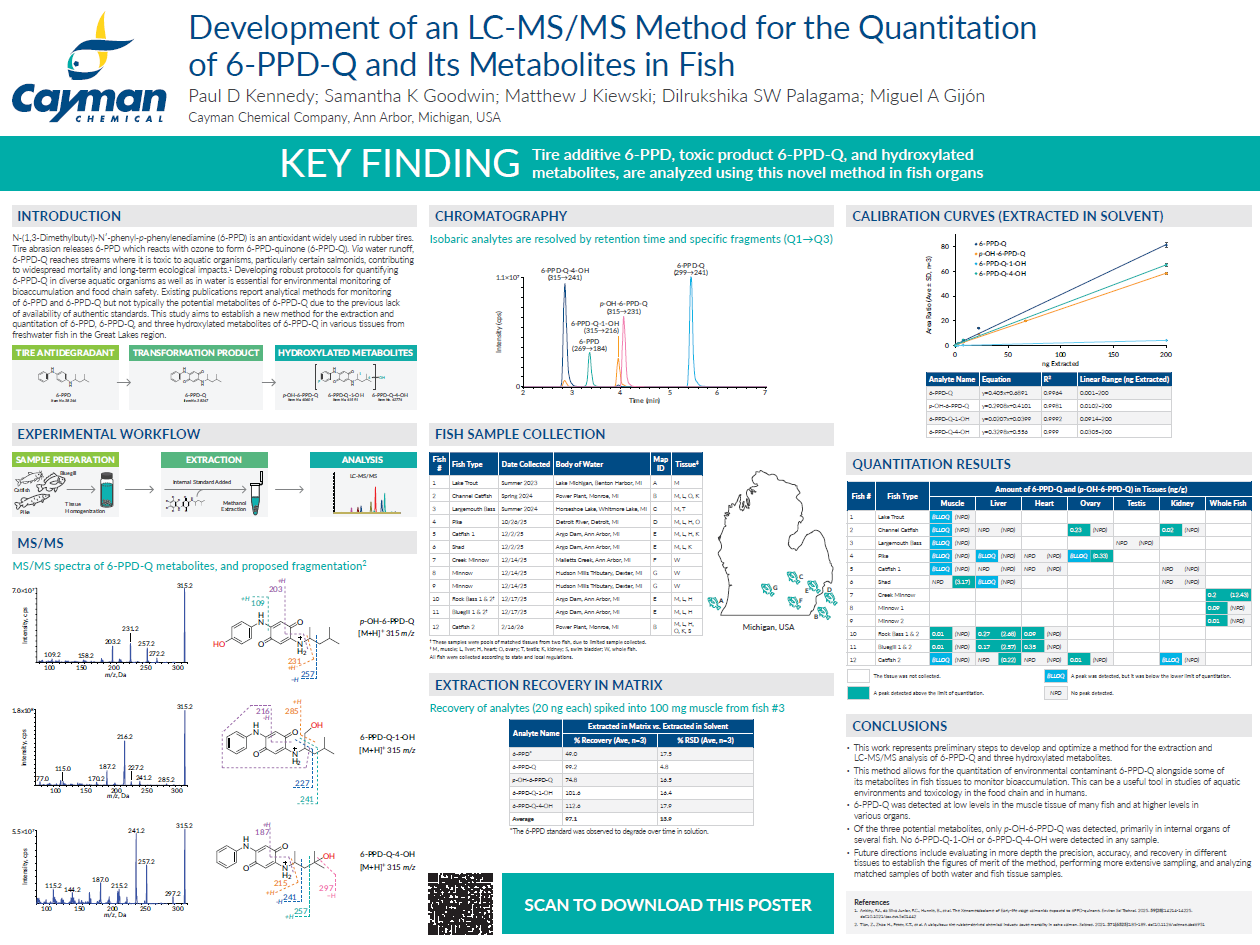
Developing robust protocols for quantifying 6-PPD-Q in diverse aquatic organisms as well as in water is essential for environmental monitoring of bioaccumulation and food chain safety. Existing publications report analytical methods for monitoring of 6-PPD and 6-PPD-Q but not typically the potential metabolites of 6-PPD-Q due to the previous lack of availability of authentic standards. This study aims to establish a new method for the extraction and quantitation of 6-PPD, 6-PPD-Q, and three hydroxylated metabolites of 6-PPD-Q in various tissues from freshwater fish in the Great Lakes region.
Do you have a question or comment for the presenter? Let us know.
To cite this poster: Kennedy, P.D., Goodwin, S.K., Kiewski, M.J., et al. Development of an LC-MS/MS Method for the Quantitation of 6-PPD-Q and Its Metabolites in Fish. Poster presented at: 74th ASMS Conference on Mass Spectrometry; May 31 – June 4, 2026; San Diego, CA.
ApoE3 Lipid Particles Assembly, Dynamics, and Biological Roles
Scientific posters
Apolipoproteins are a diverse class of lipid-binding proteins that regulate lipid transport, metabolism, and cellular signaling. Major families, including ApoA, ApoB, ApoC, ApoD, ApoE, ApoH, ApoJ (clusterin), ApoL, and ApoM, serve as structural components of lipoproteins and modulators of lipid-associated pathways. Apolipoprotein E (ApoE) is critically involved in the pathogenesis of Alzheimer’s disease and exists in three major isoforms (ApoE2, ApoE3, and ApoE4) which differentially influence the disease risk and progression. ApoE3 exhibits relatively stable lipid interactions and supports more effective amyloid clearance compared to pathogenic isoforms, thereby reducing neurotoxicity. Since ApoE3 drives receptor-mediated interactions, ApoE3:POPC:cholesterol nanoparticles provide a physiologically relevant and tunable platform to study receptor-mediated lipid efflux and cellular lipid trafficking. Here we demonstrate how ApoE3-POPC and ApoE3-POPC-Cholesterol nanoparticles enhance the efflux of fluorescently tagged saturated fatty acids and cholesterol.
Do you have a question or comment for the presenter? Let us know.
To cite this poster: Khatri, Y., Bae, J.-Y., Anders, A., et al. ApoE3 Lipid Particles: Assembly, Dynamics, and Biological Roles. Poster presented at: 2026 Lipids@Wayne Research Symposium; May 5 – 6, 2026; Detroit, MI.
Validation and Characterization of Anti-Citrulline Antibodies and Citrullinated Proteins
Scientific posters
Do you have a question or comment for the presenter? Let us know.
To cite this poster: Muzzarelli, K., Bickel, J., Norris, C., et al. Validation and Characterization of Anti-Citrulline Antibodies and Citrullinated Proteins. Poster presented at: 21st Annual Drug Discovery Chemistry Conference; April 13-16, 2026; San Diego, CA.
Effective Screening of LNP Formulations with Centrifugal Microfluidics Devices
Scientific posters
Exploring Proteus mirabilis Cyclic Dinucleotide Signaling Network Phenotypes During Biofilm Formation
Scientific posters
Proteus mirabilis is the causative agent of up to 44% of catheter-associated urinary tract infections (UTIs). P. mirabilis has an arsenal of pathogenic strategies including swarming motility, urease production, and fimbria and biofilm formation. Cyclic dinucleotides (CDNs) play a crucial role in biofilm formation by regulating the transition between motile and stationary lifestyles via production and secretion of adhesins, polysaccharides, and DNA, all of which contribute to the stability of the extracellular matrix.
In this study, we explored the regulatory network of P. mirabilis HI4320 biofilm by utilizing BV-BRC and BioCyc databases to identify 14 genes with sequence similarity to enzymes involved in dinucleotide synthesis activity or its regulation. Investigating CDN regulation could lead to new strategies for disrupting biofilm formation and the prevention of antibiotic-resistant bacterial infections.
Do you have a question or comment for the presenter? Let us know.
To cite this poster: Forsyth, V., Owen, T., Koch, A., et al. Exploring Proteus mirabilis cyclic dinucleotide signaling network phenotypes during biofilm formation.
Poster presented at: ASM Microbe Annual Meeting 2025; June 19-23, 2025; Los Angeles, CA.
Evaluation of the Quantification Capabilities of Untargeted Lipidomics Approaches
Scientific posters
Untargeted lipidomics uses MS to analyze hundreds of molecular species in biological samples. Single-point calibration based on the known amounts of internal standards is used in many studies, especially those using shotgun (i.e., without chromatography) MS analysis, but questions remain about the accuracy of single-point calibration compared to the traditional interpolation in multipoint calibration curves, as well as its suitability in LC-MS studies, where internal standards may not coelute with most of the endogenous analytes.
The objective of this study is to assess the accuracy of quantitation of lipids in human plasma by LC-MS using either single-point or multipoint calibration curves with authentic or surrogate lipid standards, using a new preparation of human reference plasma and methods validated by comparison with published values from the NIST SRM 1950 Metabolites in Human Plasma material.
Do you have a question or comment for the presenter? Let us know.
To cite this poster: Kennedy, P.D., Palagama, D.S.W., Kwiatkowski, M.J., et al. Evaluation of the quantification capabilities of untargeted lipidomics approaches. Poster presented at: 73rd Conference on Mass Spectrometry and Allied Topics; June 1-5, 2025; Baltimore, MD.
Characterization of Human Plasma as a Reference Material for Lipid Analysis Using LC-MS
Scientific posters
Lipids are key molecules in maintaining cellular membranes, in energy storage, cellular signaling, and many other biological processes. Mass spectrometry has become the gold standard for analyzing lipids and understanding their roles in health and disease, and well-characterized reference materials increase confidence in lipid quantitative data by validating the analytical methods employed.
The objective of this study is to characterize a preparation of human plasma as a reference for the analysis of a wide variety of lipids, using both targeted and untargeted LC-MS-based methods which are validated by comparison with the NIST SRM 1950 Metabolites in Human Plasma material.
View the reference data (.xlsx)
Do you have a question or comment for the presenter? Let us know.
To cite this poster: Kwiatkowski, M.J., Goodwin, S.K., DeLoy, S.L., et al. Characterization of human plasma as a reference material for lipid analysis using LC-MS. Poster presented at: 73rd Conference on Mass Spectrometry and Allied Topics; June 1-5, 2025; Baltimore, MD.
Lipid Nanoparticle (LNP) Components Dictate the Cellular Immune Response to Vaccination
Scientific posters
In this study, we formulated LNPs with SARS-CoV-2 Spike mRNA as a model antigen. The LNPs were based on established ionizable lipids, and some included putative adjuvants as additional components of the LNPs. A cohort of mice was immunized, and immune responses were assessed by ELISA for total and neutralizing antibody production, flow cytometry for T cell subsets, and ELIspot for Spike peptide-specific immune responses. We found that the different LNP formulations stimulated different aspects of the immune response, which can inform future approaches to vaccine development.
Do you have a question or comment for the presenter? Let us know.
To cite this poster: Rumble, J.M., Gronevelt, J.P., Blanks, A., et al. Lipid nanoparticle (LNP) components dictate the cellular immune response to vaccination. Poster presented at: The Annual Meeting of the American Association of Immunologists; May 3-7, 2025. Honolulu, HI.
Lipid Nanoparticle SARS-CoV-2 Vaccine-Mediated Immunopeptidome Identification
Scientific posters
In this study, LNPs encoding SARS-CoV-2 Spike protein were formulated with several different lipids proposed to stimulate immune responses. These LNPs were used to transfect human monocyte-derived dendritic cells (MDDCs), and Spike-derived MHC class I and class II peptides were identified. Evaluation of immunopeptidomic differences between these formulations as well as understanding of resulting immune responses will help the design of vaccine LNPs in the future.
Do you have a question or comment for the presenter? Let us know.
To cite this poster: Rumble, J.M., Gronevelt, J.P., Nyayapathy, S., et al. Lipid nanoparticle SARS-CoV-2 vaccine-mediated immunopeptidome identification. Poster presented at: The Annual Meeting of the American Association of Immunologists; May 3-7, 2025. Honolulu, HI.
Lipid Nanoparticle Screening in 2D vs 3D Cultures: Ovarian Cancer Cell Lines Exhibit Different Preference for Optimal Lipid Formulation in Monolayers vs Spheroids
Scientific posters
In this study, we investigated the expression of three different nucleic acid cargo types (mCherry mRNA, GFP DNA and Cy5-labeled 2′3′-cGAMP) delivered to three different ovarian cancer cell lines via four loadable LNPs containing benchmark lipids SM-102, ALC-0315, (S)-C12-200, or DLin-MC3. We then compared the relative efficacy of each formulation in delivering each payload to the various ovarian cancer cells (PA-1, SK-OV-3, and Caov-3) cultured as monolayers vs spheroids to assess whether the optimal LNP formulation is consistent across 2D and 3D culture models.
Do you have a question or comment for the presenter? Let us know.
To cite this poster: Taylor, D., Forsyth, V., Riddering, C., et al. Lipid nanoparticle screening in 2D vs 3D cultures: Ovarian cancer cell lines exhibit different preference for optimal lipid formulation in monolayers vs spheroids. Poster presented at: American Association for Cancer Research Annual Meeting 2025; April 25-30, 2025; Chicago, IL.
Lipid Nanoparticle-Mediated In Vitro Transfection of Microbubble-Activated T Cells
Scientific posters
CAR-T cell therapy is a groundbreaking form of immunotherapy, with seven US FDA-approved therapies for hematological malignancies and ongoing investigations for solid tumors. This autologous therapy includes harvesting patient’s T cells, engineering them to express CAR constructs, and transfusing them back into the patient to target and destroy cancer cells. In this study, we evaluated five LNP formulations to express a reporter gene (eGFP mRNA) in microbubble-CD3/CD28-activated T cells and stimulated with IL-2 and IL-7.
Do you have a question or comment for the presenter? Let us know.
To cite this poster: Nyayapathy, S., Gronevelt, J.P., Holcomb, E., et al. Lipid nanoparticle-mediated in vitro transfection of microbubble-activated T cells. Poster presented at: American Association for Cancer Research Annual Meeting 2025; April 25-30, 2025; Chicago, IL.
Enhancing Transfection Efficiency of Primary Immune Cells Through Lipid Nanoparticle-mediated Delivery
Scientific posters
In Vivo Investigation of pDNA Delivery Using Various Lipid Nanoparticle Formulations in A549 and Huh7 Cell Lines
Scientific posters
In this study, we investigated the efficiency of LNPs loaded with GFP-encoding pDNA using several previously published ionizable lipids, including DLin-MC3-DMA (MC3), CIN-16645 (LP-01), ALC-0315, 4A3-SC8, and DOTAP (SORT), SM-102, and β-sitosterol as a cholesterol analogue in SM-102. Key formulation characteristics, such as polydispersity index (PDI), Z-average diameter (Z-Avg), encapsulation efficiency (%EE), and freeze-thaw stability, were examined through plate-based methods. Our results show that all LNP formulations achieved ≥85% encapsulation of pDNA-eGFP with PDI values ≤0.10, indicating efficient nanoparticle formation. Next, we evaluated the transfection efficiency and mean fluorescence intensity (MFI) of pDNA-loaded LNPs in Huh-7 hepatocytes and A549 lung epithelial cells. We show that pDNA-eGFP-loaded LNPs exhibited comparable GFP intensities, with slightly lower transfection efficiencies than mRNA-loaded LNPs. Both Huh-7 and A549 cells were successfully transfected with pDNA-encapsulated LNPs
Do you have a question or comment for the presenter? Let us know.
To cite this poster: Konopka, S., Stewart, S., Gronevelt, J.P., et al. In vivo investigation of pDNA delivery using lipid nanoparticle formulations in A549 and Huh7 cell lines. Poster presented at: Cell Bio 2024; December 14-18, San Diego, CA.
Fragment-Based Drug Discovery (FBDD) Approach for IRAK4
Scientific posters
Creating Custom Cannabis CRM Mixtures: Forty-seven Phytocannabinoids, One HPLC Method
Scientific posters
Production of certified reference materials (CRMs) is prescribed by the conformity assessment standard ISO 17034:2016. Creating multi-component mixtures can present arduous challenges to ensure these criteria are met.
Apolipoprotein E: Purification, Characterization, and Lipid Nanoparticle Uptake Enhancement
Scientific posters
Beyond its implications in disease, apoliporotein E (ApoE) has been implicated in the intricate process of lipid nanoparticle (LNP) uptake. Recent studies have revealed the essential role of ApoE in facilitating the cellular internalization of LNPs, providing a potential avenue for targeted drug delivery and therapeutic interventions. In this study we have expressed and purified all three ApoE isoforms and characterized their binding properties to cognate ligands by surface plasmon resonance (SPR). Furthermore, we show that Cayman-produced LNP uptake is enhanced by addition of exogenous ApoE in a cell-based assay with lung epithelial cells.
Do you have a question or comment for the presenter? Let us know.
To cite this poster: Guerra, A.J., Muzzarelli, K.M., Gronevelt, J.P., et al. Apolipoprotein E: Purification, characterization, and lipid nanoparticle uptake enhancement. Poster presented at: PEGS Boston Summit; May 13-17, 2024. Boston, MA.
Synthesis and Characterization of New Octadecanoid Standards
Scientific posters
Oxylipins, produced by the oxidation of polyunsaturated fatty acids (PUFAs), are lipid mediators involved in a variety of biological mechanisms of health and disease. Octadecanoids are 18-carbon oxylipins derived from linoleic or linolenic acids, and they are increasingly recognized as having important effects in biological responses. This study shows the synthesis and characterization of twelve new standards for epoxy-octadecadienoic acids (EpODEs) and dihydroxy-octadecadienoic acids (DiHODEs) derived from α-linolenic acid (ALA) and γ-linolenic acid (GLA), which expand the availability of biochemical tools to further investigate the biological roles of octadecanoids.
Do you have a question or comment for the presenter? Let us know.
To cite this poster: DeLoy, S., Dittmer, J., LaGory, D., et al. Synthesis and Characterization of New Octadecanoid Standards. Poster presented at: 5th EpiLididNET Action Meeting; May 13-15, 2024. Dresden, Germany.
Improved Identification of Allele-specific MHC class II Immunopeptidome
Scientific posters
In this study, we have developed a workflow to improve the experimental identification of allele-specific MHC class II-associated peptides by biotinylating the α chain of HLA-DR in live cells. This was accomplished using the HLA-DR-null HL-60 cell line, cotransfecting with BirA and Avi-tagged MHC expression constructs. Supply of exogenous biotin ensured the specific biotinylation of MHC, which was then enriched from lysates using either streptavidin or HLA-DR-specific antibody. Peptides were eluted from these complexes and identified by mass spec. This procedure successfully captured all HLA-DR expressed by the cells and peptides identified by the traditional immunoaffinity approach were compared with the biotinylation approach.
Do you have a question or comment for the presenter? Let us know.
To cite this poster: Ho, B., Good, P., Nyayapathy, S., et al. Improved identification of allele-specific MHC class II immunopeptidome. Poster presented at: The Annual Meeting of the American Association of Immunologists; May 3-7, 2024. Chicago, IL.
Modulation of ENPP1 Activity and 2’3’-cGAMP Degradation in Ovarian Cancer Cell Lines via Loadable Preformed Lipid Nanoparticles
Scientific posters
Calcium-dependent Hit Identification for PAD4 Inhibitors with FDA-approved and Fragment-based Library Approaches
Scientific posters
Do you have a question or comment for the presenter? Let us know.
Fragment-Based Drug Discovery (FBDD) Approach for Acetylcholinesterase
Scientific posters
Acetylcholinesterase (AChE) is an enzyme that has been identified in Alzheimer’s disease (AD). It is thought to accelerate Aβ aggregation by a rapid increase in hydrolysis of acetylcholine leading to a reduction in cholinergic receptor stimulation and memory loss. Design of small molecule AChE inhibitors has been successful but with limited clinical benefits due to extensive side effects. In this study, we followed a fragment-based drug discovery (FBDD) screening approach to provide insight into designing small molecule inhibitors directly targeting AChE.
Do you have a question or comment for the presenter? Let us know.
To cite this poster: Muzzareli, K., Abdel-Haq, R., Huxkley, A. et al. Fragment-based drug discovery (FBDD) approach for acetylcholinesterase. Poster presented at: 19th Annual Drug Discovery Chemistry Conference; April 1-4, 2024. San Diego, CA.
Biochemical and Biophysical Characterization of Human Secretory Phospholipases
Scientific posters
Secretory phospholipase A2 (sPLA2) catalyzes the hydrolysis of sn-2 acyl bond of membrane-bound phospholipids yielding a free fatty acid and a lysophospholipid. The sPLA2 family contains 10 catalytically active (IB, IIA, IID, IIE, IIF, III, V, X, and XIIA) and one inactive isoform (XIIB) in mammals. This family of enzymes are disulfide-rich, low molecular weight, Ca2+-requiring lipolytic enzymes with a His-Asp catalytic dyad. Individual mammalian sPLA2s have distinct enzymatic properties and display distinct tissue expression patterns, suggesting that each enzyme acts on a distinct phospholipid membrane.
Here we describe the comparative activity of sPLA2-IIA, sPLA2-IID, sPLA2-IIE, sPLA2-V, and sPLA2-X in the presence and absence of inhibitors.
Do you have a question or comment for the presenter? Let us know.
To cite this poster: De Silva, A.J., Muzzarelli, K.M., Good, P.D., et al. Biochemical and biophysical characterization of human secretory phospholipases. Poster presented at: 20th Annual Discovery on Target Conference; September 25-28, 2023. Boston, MA.
Development and Testing of IHC-Specific Antibodies at Cayman Chemical
Scientific posters
Immunohistochemistry (IHC) is a preferred application in clinical and academic research that allows for the specific detection of a target of interest using antibodies. Researchers can determine organ and cell type information in normal and disease state tissues, provided that high-quality specific antibodies are available. However, tools and reagents necessary for IHC testing can be costly and/or not accessible to some labs. Cayman Chemical has extensive experience with antigen and antibody development and has now optimized tissue sectioning and IHC testing on formalin-fixed, paraffin-embedded (FFPE) tissue blocks.
Do you have a question or comment for the presenter? Let us know.
To cite this poster: Blanks, A.E., and Bickel, J. Development and testing of IHC-specific antibodies at Cayman Chemical. Poster presented at: 2023 Michigan Life Sciences Showcase; September 18, 2023; Lansing, MI.
Immunopeptidome Profiling of Xenograft Glioma Samples
Scientific posters
Characterization of the peptides presented by MHC molecules (pMHC) on cancer cells and their immunogenic potential is key for generating anti-cancer immune responses. Experimental identification of pMHC is performed using MHC immunoprecipitation and mass spec sequencing of eluted peptides.
In the current study, we characterize the immunopeptidome of two human glioma lines, U87 and DIPG, which were grown in nude mice. As one potential complication of cells grown in mice may be contribution of mouse pMHC to the overall peptide list, we tested specific depletion of mouse MHC prior to immunoprecipitation of human MHC complexes. We analyzed all peptide lists for the actual contribution of mouse-derived peptides to the immunopeptidome and found the true contribution of murine peptides to be minimal.
Do you have a question or comment for the presenter? Let us know.
To cite this poster: Rumble, J.M., Nyayapathy, S., Jones, R., et al. Immunopeptidome profiling of xenograft glioma samples. Poster presented at: 2023 Michigan Life Sciences Showcase; September 18, 2023; Lansing, MI.
Characterization of Extracellular Vesicle Lipids in Pre-Diabetic Mice
Scientific posters
Many studies have linked extracellular vesicles (EVs) to disease progression. For example, EVs from diabetic and obese mice can induce insulin resistance while EVs from healthy mice can reverse these effects. EVs are lipid bilayer nanoparticles released from cells by a variety of mechanisms. These particles are known to contain a variety of cargo, such as lipids, proteins, nucleic acids, and other metabolites that are believed to be responsible for their cell signaling activity.
In this study, we have performed untargeted lipidomics analysis on isolated plasma EVs from healthy and diet-induced obese, prediabetic C57BL6/J mice to study potential differences in their lipid profiles.
Do you have a question or comment for the presenter? Let us know.
To cite this poster: Kennedy, P.D., Saepoo, B., Palagama, D.S.W., et al. Characterization of Extracellular Vesicle Lipids in Pre-Diabetic Mice. Poster presented at: 8th Lipidomics Forum: ILS Annual Conference; August 27-30, 2023; Vienna, Austria
Contact Info
Cayman Chemical1180 East Ellsworth RoadAnn Arbor, Michigan 48108 USAToll Free: (800) 364-9897(USA and Canada only)Fax: (734) 971-3640


