
News & Announcements
Targeting PPARs: A guide to function and structure
Article from 2018-12-14
The PPAR subfamily of nuclear receptors represents a group of peroxisome proliferators that coordinate the transcriptional activation of genes involved in lipid metabolic pathways. While PPARs display a high degree of homology at the protein level, each subtype exhibits distinct, noninterchangeable roles in energy metabolism that range from energy utilization to energy storage. PPARα—ubiquitously expressed in metabolically active tissues and abundant in the liver—helps to control fatty acid transport, reduce triglyceride levels, and increase β-oxidation, which dampens the inflammatory response. PPARδ—expressed in muscle, adipose tissue, and liver—enhances fatty acid metabolism, while also exerting an anti-inflammatory effect. PPARγ—highly expressed in adipose tissue, macrophages, and the colon—has a role in insulin sensitization, glucose metabolism, lipid metabolism, and prevention of oxidative stress.
Their functions as fatty acid sensors and regulators of energy homeostasis are activated by a structurally diverse set of ligands that range from fatty acids to hypolipidemic drugs. PPARs heterodimerize with the 9-cis-retinoic acid receptor (RXR) and, when activated by ligand, bind to target genes through a cis-acting regulatory region called peroxisome proliferator response element (PPRE). Both the DNA binding site and hinge region of PPAR form an extensive interaction with the PPRE.
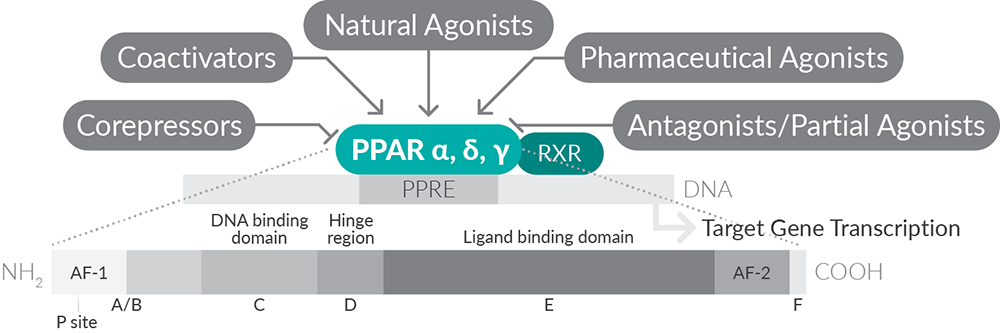
In the absence of ligand, the PPAR-RXR heterodimer remains bound to the nuclear receptor corepressor (NCoR) and silencing mediator of retinoid and thyroid hormone receptor (SMRT). SMRT facilitates the recruitment of histone deacetylases (HDACs) to the DNA promoters bound by specific interacting transcription factors. Another corepressor, receptor-interacting protein 140 (RIP140), also known as nuclear receptor-interacting protein 1 (NRIP1), directly recruits HDAC and represses activity by competing with coactivators. Thus, corepressors subdue PPAR target gene transcription by causing the deacetylation of histones.
Upon ligand binding, activation of the PPAR-RXR heterodimer through chemical interaction with the PPAR and RXR ligand binding domains triggers conformational changes in the receptor, which releases the corepressor complex and recruits cofactor complexes to the promoter region of target genes to initiate transcription. Transcription coactivators increase gene transcription through the acetylation of histones and through the recruitment and stabilization of transcriptional complexes. Cayman offers a selection of subtype-specific agonists, partial agonists, and antagonists to help identify the functional output of PPARα, PPARδ, and PPARγ receptors.
PPAR Ligands from Cayman
Get the guide to PPAR function and structure.
Additional Reading
Targeting Novel NAFLD/NASH Therapeutics
Targeting PPARβ/δ For Weight Loss: Exercise in a Pill
Contact Info
Cayman Chemical1180 East Ellsworth RoadAnn Arbor, Michigan 48108 USAToll Free: (800) 364-9897(USA and Canada only)Fax: (734) 971-3640


