
News & Announcements
Tools to Study Eicosanoid GPCR Signaling
Article from 2021-02-22
Lipids, as an entire class of biomolecules, cover a broad range of species. Some serve primarily as structural components of cell membranes or as energy storage depots, while others are active signaling molecules that are generated by cell activation events. Many signaling lipids bind to G protein-coupled receptors (GPCRs) to transmit signals that affect numerous biological activities. This includes platelet activation, vasoconstriction/dilation, leukocyte chemoattraction, smooth muscle constriction, and many others. The major eicosanoids—prostaglandins, thromboxanes, and leukotrienes—mediate biological effects by binding with specific Gs-, Gi-, or Gq-coupled receptors. Several GPCRs have been deorphanized by the discovery of eicosanoids activating their signaling. We’ve created a wall poster to delineate what is currently known about these distinct pathways.
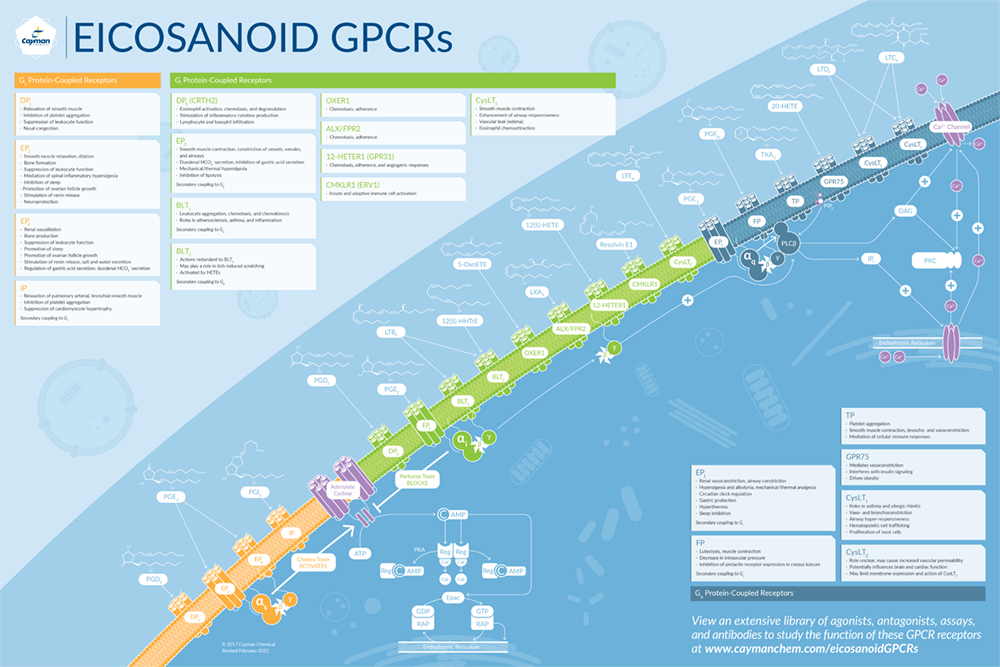
Request a wall poster
Cayman offers an extensive library of agonists, antagonists, assays, and antibodies to study the function of these receptors. Use the tables below to navigate to research products associated with each eicosanoid GPCR.
Gi These receptors couple to Gi to inhibit cyclic AMP production and to mobilize intracellular calcium. | DP2 (CRTH2) actions | Agonists | Antagonists | Assays & Antibodies |
Activates eosinophils; mediates chemotaxis and degranulation | PGD2 | AZD 1981 | CRTH2/DP2 Receptor (N-Term) Polyclonal Antibody | |
| EP3 actions | Agonists | Antagonists | Assays & Antibodies | |
· Contracts smooth muscle; constricts vessels, venules, and airways | PGE2 | EP3 Receptor Polyclonal Antibody | ||
| BLT1 actions | Agonists | Antagonists | Assays & Antibodies | |
· Mediates leukocyte aggregation, chemotaxis, and chemokinesis Secondary coupling to Gq | LTB4 Ethanolamide | BLT1 Receptor Polyclonal Antibody | ||
| BLT2 actions | Agonists | Antagonist | Assays & Antibody | |
· Actions redundant to BLT1 Secondary coupling to Gq |
| BLT2 Receptor Polyclonal Antibody | ||
| OXER1 actions | Agonists | Antagonist | Antibody | |
· Stimulates chemotaxis and adherence | ||||
| ALX/FPR2 actions | Agonists | Antagonists | Assay & Antibody | |
Stimulates chemotaxis and adherence | Unknown | |||
| 12-HETER1 (GPR31) actions | Agonist | Antagonists | Antibodies | |
Stimulates chemotaxis, adherence, and angiogenic responses | Unknown | GPR31 (N-Term) Polyclonal Antibody | ||
| CMKLR1 (ERV1) actions | Agonist | Antagonists | Antibody | |
Activates innate and adaptive immune cells | Unknown | CMKLR1 Polyclonal Antibody | ||
| CysLTE actions | Agonist | Antagonist | Assay | |
Contracts smooth muscle | LTE4 | Montelukast | LTE4 ELISA Kit |
| Gq These receptors couple to Gq to activate phospholipase C, which sets off a signaling cascade that ultimately releases stored calcium and activates protein kinase C. | EP1 actions | Agonists | Antagonists | Assays & Antibody |
· Constricts airways; mediates renal vasoconstriction Secondary coupling to Gi | EP1 Receptor Polyclonal Antibody | |||
| FP actions | Agonists | Antagonists | Assays & Antibody | |
Mediates luteolysis, muscle contraction Decreases intraocular pressure Secondary coupling to Gs | PGF2α | AL 8810 | FP Receptor Polyclonal Antibody | |
| TP actions | Agonists | Antagonists | Assays & Antibodies | |
· Aggregates platelet | AH 23848 | TP Receptor (mouse) Polyclonal Antibody | ||
| GPR75 actions | Agonists | Antagonist | Assays & Antibodies | |
· Mediates vasoconstriction |
| |||
| CysLT1 actions | Agonists | Antagonists | Assays & Antibodies | |
Roles in asthma and allergic rhinitis | BAY u9773 | CysLT1 Receptor Polyclonal Antibody | ||
| CysLT2 actions | Agonists | Antagonists | Assays & Antibodies | |
Role unclear, may cause increased vascular permeability | CysLT2 Receptor (N-Term) Polyclonal Antibody
|
The Prostaglandin Screening ELISA Kit was developed for screening applications in which the relative amount of prostaglandin production for a large number of cell culture samples must be determined. The antiserum used in this assay exhibits high cross reactivity for most prostaglandins (e.g., PGE1α, PGE2α, PGF1α, PGF2α, PGF3α), which allows for the quantification of all the prostaglandins in a given sample within a single assay. A full specificity profile can be viewed in the kit booklet (PDF).
Additionally, the Prostaglandin Screening Libraries and Bio-Active Lipid Screening Libraries offer a collection of Cayman's extensive, highly purified prostaglandin compounds conveniently packaged in a ready-to-use format in a 96-well Matrix tube rack as stock solutions in DMSO. These libraries are a cost-effective means to obtaining compound diversity and are amenable to high-throughput screening.
Explore more products to study the Cyclooxygenase, Cytochrome P450, and Lipoxygenase pathways available from Cayman
Cayman's scientists are lipid experts. If you need help with a custom synthesis, sample analysis, compound screening, or assay development, our scientists are here to help. Contact us to request a quote.
You May Also Be Interested In
 Eicosanoid Enzymology and Metabolism |  Eicosanoid Sample Collection, Preparation, and Storage Advice |
 Arachidonic Acid Cascade Wall Poster |  Meet the Expert: Biomarker Development |
Contact Info
Cayman Chemical1180 East Ellsworth RoadAnn Arbor, Michigan 48108 USAToll Free: (800) 364-9897(USA and Canada only)Fax: (734) 971-3640


